

Understanding the methods of determining the tax base is one of the most practical skills any business owner or financial manager needs. Without a clear grasp of how tax authorities calculate the value on which your tax liability is built, you’re essentially navigating financial obligations with a blindfold on. Get it wrong, and the penalties can be serious.
For businesses operating in Saudi Arabia, the stakes are even higher given the evolving regulatory landscape and the increasing scrutiny from ZATCA. That’s exactly why working with a qualified certified accounting office like OMK makes a genuine difference — not just during tax season, but year-round. OMK brings the kind of structured, expert-led approach that turns a complex compliance obligation into a manageable, predictable process.
What Is Meant by the Tax Base?
The tax base, in its simplest form, is the measurable value or amount on which a tax is calculated. Think of it as the foundation — before you can know how much tax is owed, the authority first needs to establish what is being taxed and how much of it exists. The tax base might be income, the value of goods sold, imported merchandise, or even a company’s net assets, depending on the type of tax in question.
What’s interesting here is that the tax base is not the same as the tax itself. It’s the raw input that gets multiplied by the applicable tax rate to produce the actual liability. A misidentified or incorrectly valued tax base can either inflate what a business owes or leave it vulnerable to under-reporting penalties. This is why precision in defining and measuring the tax base is non-negotiable for any serious financial operation.
Types of Tax Base

Different taxes draw on different bases, and each type has its own logic and measurement methodology. Taxes in Saudi Arabia span several categories, and each is anchored to a specific base that determines how liability is calculated. Understanding the landscape of these types is essential before diving into how they are determined.
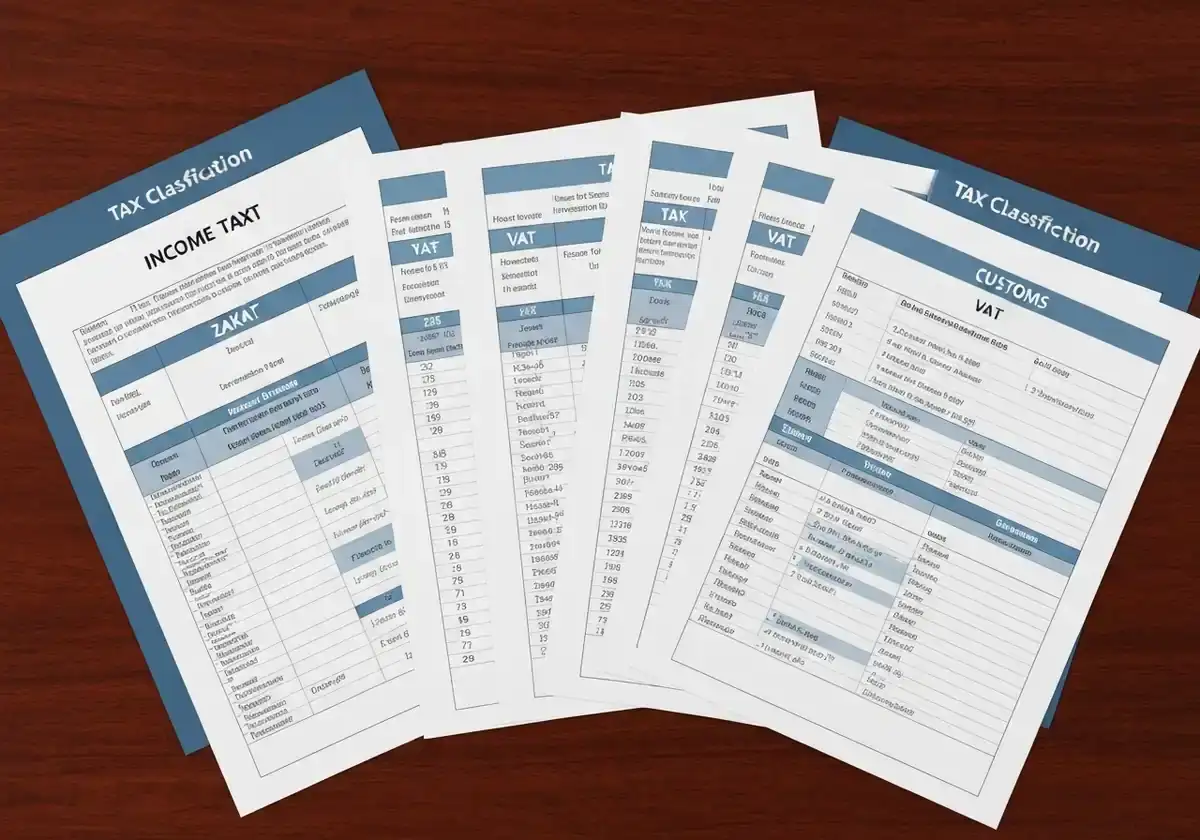
Across the Saudi tax system and beyond, the four most relevant categories that businesses encounter regularly are income tax, value-added tax, customs duties, and zakat. Each operates with its own rules, its own applicable base, and its own filing mechanics. A certified accounting office handles all of these routinely and ensures that the correct base is identified and properly valued for each.
1. Income Tax
- Income tax applies to the taxable income of foreign investors and non-Saudi shareholders operating within the Kingdom.
- The base here is net taxable income — meaning gross revenue minus allowable deductions such as operational costs, depreciation, and approved expenses.
- The standard corporate income tax rate in Saudi Arabia is 20%, applied directly to this calculated base.
- Capital gains realized from the disposal of assets are typically included within the income tax base unless specific exemptions apply.
- Accurate bookkeeping and expense documentation are critical because every deduction that is properly supported reduces the base — and therefore the tax owed.
2. Value Added Tax (VAT)
- VAT in Saudi Arabia is currently set at 15%, and it applies to the value added at each stage of a supply chain.
- The tax base for VAT is the consideration received for a taxable supply — essentially, the selling price before VAT is added.
- Businesses must track both output VAT (charged on sales) and input VAT (paid on purchases) to determine the net amount payable.
- Certain supplies are zero-rated or exempt, which directly affects how the base is calculated for those transactions.
- Errors in VAT base calculation are among the most common compliance issues flagged during ZATCA audits.
3. Customs Duties
- The customs tax base is generally the customs value of the imported goods, determined using the WTO Customs Valuation Agreement principles.
- Transaction value — what was actually paid for the goods — is the primary method, adjusted where necessary for freight, insurance, and other costs.
- The applicable duty rate is then applied to this assessed customs value to determine the amount owed.
- Misclassification of goods under the Harmonized System codes can lead to incorrect base calculations and subsequent disputes with customs authorities.
- A certified accounting office familiar with import operations can flag these risks before they become costly corrections.
4. Zakat
- Zakat applies to Saudi and Gulf Cooperation Council (GCC) nationals and Saudi companies, and its base is fundamentally different from income tax.
- The zakat base is calculated on the company’s net worth or zakatable funds — broadly, working capital adjusted according to specific ZATCA guidelines.
- Items such as long-term fixed assets are generally excluded from the zakat base, while cash, receivables, and inventory are typically included.
- The zakat rate is 2.5%, but this seemingly small figure can represent a significant liability if the base is not properly managed and documented.
- Zakat calculations require a deep understanding of Islamic finance principles combined with practical knowledge of ZATCA’s administrative rules.
Calculating the Tax Base in Saudi Arabia

Calculating the tax base in Saudi Arabia is not a one-size-fits-all exercise. The process depends entirely on which tax is being assessed, what type of entity is involved, and what financial records are available. For income tax purposes, the journey starts with the profit and loss statement, then works backward — adding back non-deductible expenses and removing non-taxable income items to arrive at the actual taxable base.
For VAT, the calculation is more transactional. Every sale and every purchase during the tax period feeds into the net VAT position. Businesses filing quarterly or monthly VAT returns need reliable accounting systems that capture this data accurately in real time. OMK’s certified accounting office maintains these systems for clients and ensures that nothing slips through the cracks during reconciliation.
The zakat base calculation is arguably the most nuanced of all. It requires a full balance sheet analysis, with specific adjustments that don’t follow standard accounting logic. Most businesses benefit enormously from having a certified accounting office run this calculation annually — both to ensure accuracy and to identify any legally available adjustments that reduce the base without crossing into avoidance territory.
The Difference Between the Tax Base and the Tax in Saudi Arabia
People often conflate these two things, and it’s an understandable confusion. The tax base is what is being measured. The tax is what is owed as a result of applying a rate to that measurement. They are related but fundamentally different concepts — and treating them interchangeably leads to genuine errors in financial planning.
Here’s the thing: a business could have an identical tax base to a competitor but end up with a very different tax liability. That happens when deductions, exemptions, or credits are applied differently. Taxes in Saudi Arabia are calculated with clear statutory rates, but the base itself is where all the real financial engineering takes place — legally, of course. A skilled certified accounting office knows exactly where those levers are.
How Is the Tax Base Determined?
The methods of determining the tax base vary depending on the tax type and the information available, but several core approaches apply across the board:
- Direct assessment method: The tax authority reviews actual financial statements, contracts, and records to determine the base from documented evidence.
- Estimated assessment method: Used when complete records are unavailable; the authority estimates the base using benchmarks, comparable businesses, or industry averages.
- Self-assessment method: The taxpayer calculates and declares their own base in a return, which is then subject to review or audit by ZATCA.
- Withholding method: Applied to specific payment types where the payer deducts tax at source and remits it directly, effectively pre-determining the base.
- Agreement-based method: In some situations, a negotiated or pre-agreed figure is used as the base, particularly in cross-border transactions subject to transfer pricing rules.
- Indirect indicators method: Authorities use external economic indicators — such as electricity usage, staff numbers, or bank deposits — to infer the likely tax base when records are absent or unreliable.
Characteristics and Components of the Tax Base
- Measurability — The base must be quantifiable in monetary or unit terms; vague or unverifiable values cannot function as a legitimate base.
- Legal definition — Each jurisdiction defines its tax base through legislation; in Saudi Arabia, ZATCA regulations and the income tax law specify exactly what is included.
- Temporal scope — The base is always tied to a specific period, whether a fiscal year, a quarter, or a single transaction event.
- Adjustability — Most bases allow for statutory deductions, exemptions, or credits that modify the raw figure before the rate is applied.
- Verifiability — Reliable documentation must support the stated base; invoices, contracts, payroll records, and bank statements all serve as evidence.
- Neutrality — A well-designed tax base is meant to reflect economic reality fairly, without distorting business decisions beyond what policy intends.
- Consistency — The same methodology should be applied period after period; arbitrary changes in how the base is calculated can trigger audit attention.
The Importance of the Tax Base
- A correctly defined tax base ensures that businesses pay exactly what the law requires — no more, no less.
- It forms the foundation for all tax planning strategies; optimizing the base (through legitimate deductions) is the primary tool for managing tax costs.
- An accurate base protects businesses from ZATCA penalties, which can include fines, surcharges, and in serious cases, criminal referrals.
- For investors and lenders reviewing a business’s financials, the reported tax base signals the quality of the accounting function and overall governance.
- Consistent and well-documented base calculations make audits faster, less disruptive, and far more likely to close without additional assessments.
- Understanding the base helps CFOs and business owners make better decisions about pricing, investment, and corporate structure.
Frequently Asked Questions
What is the difference between the tax base and the tax itself?
The tax base is the value or amount that gets measured before any rate is applied — it could be income, a transaction value, or a company’s net worth depending on the tax type. The actual tax is what results after the statutory rate is multiplied by that base. Confusing the two is a common mistake that leads to poor financial planning, because the real opportunity to manage tax costs lies in how the base is legitimately structured and documented, not in negotiating rates.
Who is responsible for calculating the tax base in Saudi Arabia?
In Saudi Arabia’s self-assessment system, the taxpayer bears primary responsibility for calculating and declaring their own tax base through the relevant return. ZATCA then has the authority to review, audit, or reassess that declaration if it identifies inconsistencies or receives information that contradicts the filed figures. This is precisely why working with a certified accounting office is so valuable — OMK prepares these calculations to a standard that withstands scrutiny from the outset.
How can a certified accounting office help with tax base determination?
The methods of determining the tax base involve technical judgments that require both legal knowledge and practical accounting expertise. A certified accounting office like OMK reviews the full financial picture — revenue streams, allowable deductions, applicable exemptions, and timing differences — to ensure that the base declared is both accurate and optimized within the law. Beyond calculation, OMK also handles the documentation trail that protects clients during audits and ensures that filing deadlines are met without last-minute scrambles.
Getting the tax base right is not a bureaucratic formality — it’s the single most important step in calculating what your business actually owes. Mastering the methods of determining the tax base puts businesses in control of their compliance posture and their overall tax costs. Whether you’re dealing with income tax, VAT, customs duties, or zakat, the quality of your base calculation determines everything downstream. OMK’s certified accounting office brings the expertise, the systems, and the regulatory knowledge to handle this correctly every time. Reach out to OMK today and put your tax compliance in hands you can trust.