
Understanding how to keep accounting books is one of the most fundamental skills any business owner or financial manager needs to develop — and yet it is one of the most misunderstood areas in day-to-day business operations. Get it right, and you have a clear financial picture at all times. Get it wrong, and the consequences range from bad decisions to legal trouble.
At OMK, our certified accounting office has helped hundreds of businesses build solid bookkeeping foundations from the ground up. Whether you are running a startup, a mid-sized company, or an established enterprise, the principles of how to keep accounting books remain consistent — and we are here to walk you through every step.
The Concept of Keeping Accounting Books
Bookkeeping, at its core, is the disciplined process of recording every financial transaction a business makes — sales, purchases, payments, receipts, and everything in between. The term “accounting books” refers to the organized ledgers and journals where these records live, forming the backbone of any sound financial system. Without them, a business is essentially operating blind.
What’s interesting here is that many people confuse bookkeeping with full accounting. They are related but distinct. Bookkeeping is the raw data collection phase — the structured recording of numbers. Accounting builds on that foundation to interpret, analyze, and report what those numbers actually mean. You cannot have reliable accounting without solid bookkeeping underneath it.
The commercial bookkeeping system used by a business must comply with local regulations and reflect the true financial state of the company at any given point. This is not optional. It is a legal and operational necessity that protects owners, investors, and stakeholders alike.
The Importance of Keeping Accounting Books
- It gives business owners an accurate, real-time view of their financial position — cash flow, liabilities, and assets become transparent rather than guesswork.
- Proper accounting books are legally required in most jurisdictions, and failure to maintain them can result in fines, audits, or prosecution.
- Banks and investors require well-maintained bookkeeping records before approving loans or funding — disorganized records kill financing opportunities instantly.
- Tax compliance becomes dramatically simpler when your accounting books are current and complete, reducing the risk of penalties from tax authorities.
- Decision-making improves at every level when leadership has access to accurate financial data rather than estimates.
- A solid commercial bookkeeping system makes business valuation straightforward if you ever plan to sell, merge, or bring in partners.
- It creates accountability within the organization — when every transaction is recorded, financial misconduct becomes far harder to hide or sustain.
Most people overlook point seven entirely. Internal fraud is far more common than external theft in small and medium businesses, and disciplined bookkeeping is one of the most effective deterrents available.
The Rules Governing How to Keep Accounting Books
- All financial transactions must be recorded chronologically, without gaps or omissions, to maintain an unbroken audit trail.
- Every entry must be supported by a source document — an invoice, receipt, bank statement, or contract — that can verify the transaction independently.
- The accounting books must be kept in the official language recognized by local commercial law, with consistent formatting throughout.
- Corrections to entries must never involve erasure or deletion; instead, a correcting entry must be made with a clear explanation and date.
- The commercial bookkeeping system must follow a consistent accounting method — either cash basis or accrual basis — and cannot switch between them without formal disclosure.
- Books must be retained for the legally required period, which in many jurisdictions ranges from five to ten years, even after the business closes.
- All entries must be balanced — every debit must have a corresponding credit — in line with the double-entry bookkeeping principle.
- Access to accounting books should be restricted to authorized personnel only, with appropriate controls to prevent unauthorized changes.
How to Keep Accounting Books Step by Step
- Identify all financial transactions as they occur, including sales, expenses, payroll, asset purchases, and loan repayments — nothing gets recorded later from memory.
- Classify each transaction into the correct account category: revenue, expense, asset, liability, or equity.
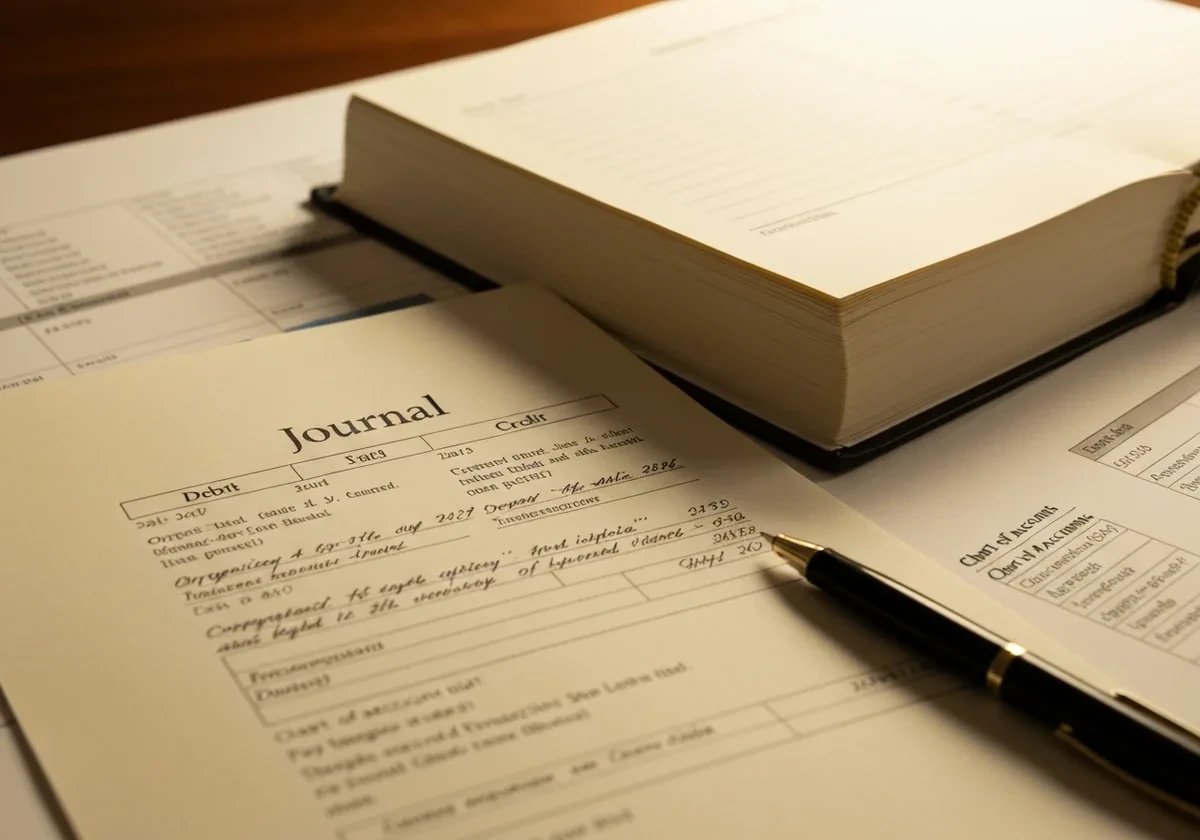
- Record each transaction in the daily journal (the Journal Book) using the double-entry system, noting both the debit and credit sides clearly.
- Post each journal entry to the appropriate account in the General Ledger, which organizes transactions by account type rather than by date.
- Reconcile your records against bank statements at regular intervals — weekly or monthly — to catch discrepancies before they compound.
- Prepare a trial balance at the end of each accounting period to confirm that total debits equal total credits across all accounts.
- Generate financial statements — income statement, balance sheet, and cash flow statement — from the reconciled trial balance.
- Archive all supporting documents alongside the corresponding book entries so that any transaction can be traced and verified within minutes.
Here’s the thing — this process sounds sequential and clean on paper, but in practice it demands consistency and attention to detail that most business owners simply do not have time to maintain alone. That is precisely why OMK’s certified accounting office exists: to take this off your plate and do it properly.
Types of Accounting Books
Understanding the different types of accounting books is essential before you can implement a reliable system. Each book serves a distinct purpose, and together they form a complete picture of a company’s financial activity. Let’s walk through each one.
The Daily Journal
- Records every financial transaction in chronological order as it occurs throughout the business day.
- Uses the double-entry system, meaning each transaction appears as both a debit and a credit entry.
- Serves as the primary source document that feeds all other accounting books.
- Must be updated daily — any delay creates a backlog that distorts the financial picture.
The General Ledger
- Organizes all transactions by account type rather than by date, giving a cumulative view of each account’s activity.
- Draws its data directly from the daily journal through a process called “posting.”
- Forms the basis for preparing the trial balance and, ultimately, the financial statements.
- Is often considered the most important single document in the entire accounting books system.
The Cash Book
- Tracks all cash inflows and outflows — both physical cash and bank transactions — in a single dedicated record.
- Must be reconciled against bank statements regularly to detect errors, missing entries, or unauthorized withdrawals.
- Provides an instant snapshot of the business’s liquidity at any given moment.
- Is particularly critical for retail businesses and any operation where cash transactions are frequent.
The Inventory Book
- Records the movement of goods in and out of stock — purchases, sales, returns, and adjustments.
- Helps management monitor stock levels, identify slow-moving items, and prevent theft or unexplained shrinkage.
- Is essential for cost of goods sold calculations, which directly affect profit reporting.
- Must be reconciled against physical stock counts at regular intervals to remain reliable.
The Inventory Ledger (Year-End Stocktake)
- Used at the close of each financial year to record a full valuation of all assets, liabilities, and equity.
- Provides the data needed to prepare the balance sheet and confirm the business’s net worth.
- Requires physical verification of all tangible assets — equipment, inventory, property — not just paper records.
- Any discrepancy between book values and physical counts must be investigated and explained before closing the accounts.
The Securities Book
- Tracks financial instruments held by the business — shares, bonds, promissory notes, and similar instruments.
- Records the acquisition date, face value, market value, and any income generated from each instrument.
- Is particularly relevant for businesses that maintain investment portfolios alongside their core operations.
- Must reflect any changes in value or ownership in real time to avoid misstating the company’s financial position.
Types of Accounts Used in Keeping Accounting Books
- Asset Accounts — record everything the business owns or is owed, from cash and equipment to accounts receivable and property.
- Liability Accounts — capture everything the business owes to outside parties, including loans, unpaid invoices, and tax obligations.
- Equity Accounts — represent the owner’s residual interest in the business after subtracting liabilities from assets.
- Revenue Accounts — track all income generated from the business’s primary operations as well as secondary income streams.
- Expense Accounts — record all costs incurred in running the business, from salaries and rent to utilities and marketing.
- Contra Accounts — offset the balance of a related account, such as accumulated depreciation reducing the value of a fixed asset.
The Difference Between Accounting and Keeping Accounting Books
- Bookkeeping is the process of recording raw financial transactions; accounting is the process of interpreting and analyzing that recorded data to produce meaningful financial insights.
- Bookkeeping focuses on accuracy and completeness of records; accounting focuses on judgment, analysis, and strategic financial advice.
- A bookkeeper typically works at the transactional level — entering data, reconciling accounts, and maintaining the commercial bookkeeping system day to day.
- An accountant reviews the bookkeeper’s work, applies accounting standards, prepares tax filings, audits records, and provides forward-looking financial guidance.
- Bookkeeping is largely rule-based and procedural; accounting requires professional judgment and often a certified qualification.
- Small businesses sometimes conflate the two roles, but as a company grows, separating them becomes not just helpful but necessary for financial integrity.
Common Errors That Occur When Keeping Accounting Books
- Failing to record transactions promptly — delaying entries creates memory-based errors and makes reconciliation nearly impossible.
- Mixing personal and business finances — one of the most damaging habits a business owner can develop, it corrupts the accuracy of every financial report.
- Incorrect account classification — posting an expense to the wrong category distorts profit figures and can lead to incorrect tax filings.
- Ignoring bank reconciliation — without regular reconciliation, discrepancies accumulate until they become financial crises rather than minor corrections.
- Improper correction of errors — crossing out or deleting entries rather than making proper correcting entries violates accounting standards and raises red flags during audits.
- Neglecting source documents — recording transactions without retaining the supporting invoice or receipt makes the entry unverifiable and legally vulnerable.
- Using inconsistent accounting methods — switching between cash and accrual basis without disclosure misleads stakeholders and violates commercial bookkeeping rules.
Frequently Asked Questions
What is the difference between bookkeeping and accounting?
Bookkeeping is the structured recording of every financial transaction a business makes — it is the data collection layer of financial management. Accounting takes that recorded data and applies analysis, judgment, and professional standards to produce financial statements, tax filings, and strategic advice. You need strong bookkeeping before accounting can produce anything reliable. At OMK, our certified accounting office handles both layers seamlessly, so nothing falls through the cracks.
How often should accounting books be updated?
Ideally, accounting books should be updated daily — or at minimum weekly. The longer you wait, the greater the risk of forgetting transaction details, losing source documents, and creating reconciliation headaches. Understanding how to keep accounting books means understanding that timeliness is not optional. A well-maintained commercial bookkeeping system processes entries as transactions happen, not at the end of the month when panic sets in.
Can a small business handle its own bookkeeping without a certified accountant?
Technically yes — but practically, it is rarely advisable. Small business owners are usually skilled at running their business, not at navigating accounting standards, tax regulations, and audit requirements. Simple errors in the accounting books can compound into significant financial and legal problems over time. Working with a certified accounting office like OMK gives you professional oversight, error prevention, and peace of mind that the numbers are always right.
Mastering how to keep accounting books is not just a technical exercise — it is the financial foundation your business stands on. Every smart decision, every credible financial report, every successful audit traces back to the quality of your bookkeeping. Weak records produce weak outcomes. Strong, disciplined accounting books produce clarity, compliance, and confidence.
Do not leave something this important to guesswork or to software alone. OMK’s certified accounting office brings the expertise, the systems, and the professional accountability your business deserves. Reach out to OMK today and let us build you a bookkeeping structure that actually works.