Every business decision — whether it’s securing a loan, attracting investors, or planning an expansion — rests on the reliability of its numbers. Understanding the proper steps to review financial statements is not a luxury; it is the foundation of sound financial governance. Skip a step, and the entire picture becomes distorted in ways that can cost a company far more than any audit fee ever would.
At OMK, our certified public accountant office has worked with businesses across industries to bring discipline and precision to financial reporting. We know firsthand that the review process is where errors are caught, risks are surfaced, and confidence is built. Whether you are working with corporate financial statements for a large enterprise or preparing financial statements for a growing startup, the methodology must be rigorous and systematic.
The Concept of Financial Statement Review
A financial statement review is a professional engagement where an accountant applies analytical procedures and inquiry-based techniques to provide limited assurance that the financial statements are free from material misstatement. It sits between a compilation — which offers no assurance — and a full audit, which provides the highest level of assurance. Here’s the thing: many business owners underestimate just how much value a thorough review delivers compared to simply handing over raw numbers to a lender or board.
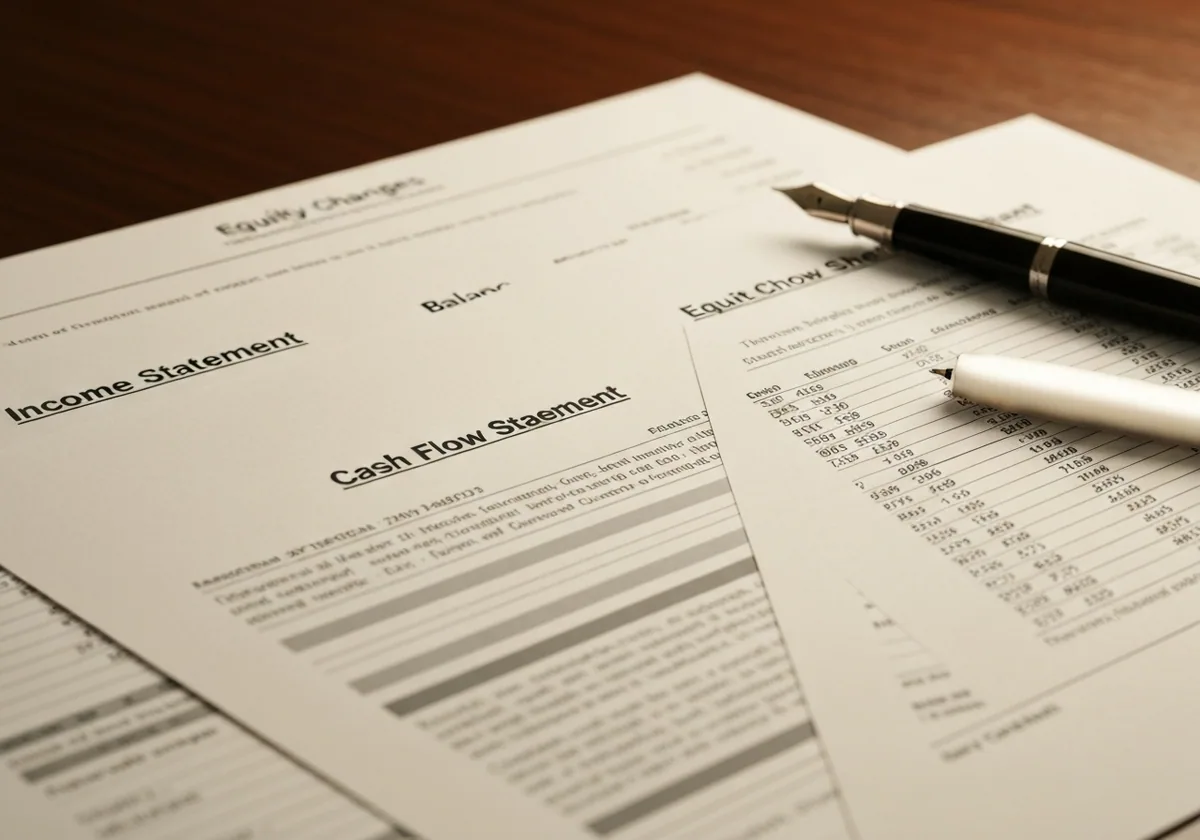
The process examines financial statements as a complete package. That means looking at the balance sheet, the comprehensive income statement, the cash flow statement, and the notes to financial statements together — not in isolation. Patterns that seem unremarkable in one statement often reveal critical issues when cross-referenced with another. Our certified public accountant office at OMK applies this holistic lens every time.
What’s interesting here is that the review concept originated from a practical business need: not every company requires a full audit, but every company needs some level of independent verification. The review fills that gap efficiently, balancing cost, time, and credibility in a way that a self-prepared report simply cannot.
How Are Financial Statements Examined?
The examination process follows a structured sequence that ensures no area is overlooked. Here is how a professional review is conducted:
- Obtain the complete financial statement package — This includes the balance sheet, comprehensive income statement, statement of changes in equity, cash flow statement, and all accompanying notes. Missing documents are flagged immediately before any analysis begins.
- Perform preliminary analytical procedures — The reviewer compares current-period figures against prior periods, budgets, and industry benchmarks. Unusual fluctuations are identified and documented for further inquiry.
- Conduct management inquiries — Formal questions are directed to management about accounting policies, significant transactions, unusual items, and subsequent events that may affect the financial statements.
- Examine financial statement templates and disclosures — The reviewer ensures that financial statement templates conform to applicable accounting standards and that all required disclosures are complete and accurate.
- Assess internal consistency — Figures across all statements are cross-checked. The net income on the income statement must reconcile with the equity movement on the balance sheet, and cash balances must agree with the cash flow statement.
- Evaluate significant estimates and judgments — Areas such as depreciation rates, bad debt provisions, and inventory valuations are scrutinized for reasonableness.
- Document findings and prepare the review report — All procedures, conclusions, and any matters requiring attention are recorded in a working file that supports the final report issued to the client.
Requirements for Reviewing Financial Statements Under International Review Standards
International standards — specifically ISRE 2400 — set clear requirements that any professional engagement must meet. At OMK’s certified public accountant office, we align every review with these standards without exception.
- The engagement must be performed by a qualified professional with sufficient knowledge of the entity’s industry and applicable financial reporting framework.
- The reviewer must maintain professional skepticism throughout the process, regardless of their familiarity with the client or management.
- Written representation letters must be obtained from management confirming the completeness and accuracy of information provided.
- Analytical procedures must cover all significant account balances and transaction classes within the corporate financial statements.
- The reviewer must document all significant judgments made during the engagement and the basis for conclusions reached.
- Any identified misstatements — whether corrected or uncorrected — must be communicated clearly to management and those charged with governance.
- Independence requirements must be maintained in both fact and appearance to preserve the integrity of the review opinion.
- The final report must clearly state the nature and scope of the review, the applicable standard followed, and the conclusion reached.
What Are the Steps to Review Financial Statements?
The steps to review financial statements form a logical chain where each phase builds on the previous one. Skipping any link weakens the entire chain.
- Plan the review engagement — Define scope, timeline, key contacts, and materiality thresholds before touching a single document.
- Gather and organize all financial data — Collect the financial statements, supporting schedules, bank statements, contracts, and prior-year reports.
- Apply ratio and trend analysis — Calculate liquidity ratios, profitability margins, leverage metrics, and turnover rates. Compare these against historical data and sector norms.
- Investigate variances and anomalies — Any ratio or figure that falls significantly outside expected ranges must be explained. No variance should be dismissed without a documented reason.
- Review accounting policy consistency — Confirm that the same policies applied last year are applied this year, and that any changes are properly disclosed in the notes.
- Assess the comprehensive income statement — Examine revenue recognition practices, cost allocation, and the treatment of other comprehensive income items that bypass the main income figure.
- Review subsequent events — Identify any events occurring after the reporting date but before the review report is issued that could materially affect the financial statements.
- Issue the review conclusion — Draft and finalize the review report, communicating the level of assurance provided and any matters requiring management’s attention.
How to Review Balance Sheet Items (Financial Position Statement Review)
The balance sheet — formally known as the statement of financial position — requires item-by-item scrutiny because it carries the cumulative effect of every transaction the business has ever recorded.
- Cash and bank balances: Agree balances to bank statements and reconciliations. Investigate any long-outstanding reconciling items.
- Trade receivables: Assess the adequacy of the bad debt provision. Confirm that the aging analysis aligns with the balance reported in the financial statements.
- Inventory: Verify that valuation method (FIFO, weighted average) is consistently applied and that slow-moving or obsolete inventory is appropriately written down.
- Fixed assets: Review the depreciation schedule for reasonableness. Check that additions and disposals during the period are properly recorded and authorized.
- Trade payables: Confirm that all payables are recorded and that no significant liabilities are omitted. Perform supplier statement reconciliations where possible.
- Loans and borrowings: Verify outstanding balances against loan agreements and confirm that covenant compliance requirements are met.
- Equity accounts: Reconcile opening and closing equity balances and confirm that any dividends declared are properly authorized and recorded.
How to Review Income Statement Items
Corporate financial statements live or die on the integrity of the income statement. Every line deserves careful attention.
- Revenue: Confirm that revenue is recognized in the correct period and in accordance with the applicable standard (IFRS 15 or equivalent). Review contracts with unusual terms or multiple performance obligations.
- Cost of goods sold: Verify the basis of cost allocation and confirm physical inventory counts support the figures reported.
- Operating expenses: Compare each expense category to prior periods and budget. Obtain explanations for any category that deviates significantly.
- Depreciation and amortization: Agree charges to the fixed asset schedule and confirm that useful life estimates remain appropriate.
- Other income and expenses: Scrutinize non-recurring items. Unusual one-time gains or losses deserve close attention to ensure they are properly classified.
- Tax expense: Verify that the current and deferred tax calculations are consistent with the applicable tax rate and the entity’s tax position.
- Net profit reconciliation: Confirm that the bottom-line profit figure reconciles correctly with the movement in retained earnings on the balance sheet.
The Four Types of Audit Reports
Understanding report types helps clients know exactly what conclusion has been reached about their financial statements.
- Unmodified (Clean) Opinion — Issued when the financial statements present fairly in all material respects. This is the best outcome and the one every well-prepared company should aim for.
- Qualified Opinion — Issued when there is a material but not pervasive misstatement or limitation of scope. The auditor agrees with most of the statements but takes exception to specific items.
- Adverse Opinion — Issued when misstatements are both material and pervasive. This means the financial statements as a whole cannot be relied upon. It is a serious outcome that demands immediate corrective action.
- Disclaimer of Opinion — Issued when the auditor cannot obtain sufficient appropriate evidence to form a conclusion, often due to significant scope limitations. No assurance is provided on the financial statements.
Best Practices for Reviewing Financial Statements
Experience across hundreds of engagements at OMK’s certified public accountant office has distilled the following practices as non-negotiable for a high-quality review.
- Start every review with a clear engagement letter that defines scope, responsibilities, timing, and fees — ambiguity at the start creates disputes at the finish.
- Maintain a structured working paper file so that every conclusion is traceable to supporting evidence. Undocumented conclusions are worthless if challenged.
- Use standardized financial statement templates as a baseline for disclosure completeness checks — they serve as a powerful checklist against which actual statements are measured.
- Communicate findings to management in real time rather than saving everything for the final report. Early communication allows issues to be resolved faster.
- Never rely solely on management representations without independent corroboration from documents, calculations, or third-party confirmations.
- Keep professional development current — accounting standards evolve, and a reviewer working with outdated knowledge creates more risk than value.
- Build a multi-year trend file so that current-year figures can be assessed against a meaningful historical baseline rather than a single prior-year comparison.
The Most Notable Characteristics of Financial Statements
For financial statements to serve their purpose, they must embody specific qualitative characteristics that are universally recognized under international reporting frameworks.
- Relevance — Information must be capable of making a difference in the decisions made by users. Irrelevant detail clutters rather than clarifies.
- Faithful Representation — The numbers must represent what they purport to represent — completely, neutrally, and free from material error.
- Comparability — Financial statements must be comparable across periods and across entities within the same industry, which requires consistent application of policies.
- Verifiability — Independent observers using the same methods should be able to reach the same conclusions from the same data.
- Timeliness — Stale information loses its decision-making value. Financial statements must be produced and reviewed within a timeframe that keeps them actionable.
- Understandability — Statements must be presented clearly enough that a user with reasonable financial knowledge can interpret them without specialized assistance.
Why Does Your Business Need a Financial Statement Review?
Some business owners still ask whether a professional review is truly necessary. The answer is yes — and here is why.
- Banks and financial institutions routinely require reviewed or audited financial statements before approving credit facilities or loan renewals.
- Investors and potential acquirers use reviewed corporate financial statements to assess valuation and risk before committing capital.
- A professional review catches errors before they compound across multiple periods, saving significant correction costs down the line.
- Regulatory bodies in many jurisdictions require periodic submission of independently reviewed financial statements for licensed entities.
- The review process itself improves internal controls — the discipline of preparing for a review forces management to tighten their bookkeeping and reporting processes.
- Tax authorities are more likely to accept financial figures that have been independently reviewed, reducing the risk of costly assessments and penalties.
- Stakeholder confidence — whether from shareholders, board members, or strategic partners — rises measurably when reviewed financial statements back the numbers.
The Certified Public Accountant’s Responsibility in Reviewing Financial Statements
The responsibility carried by a certified public accountant during a financial statement review is both professional and ethical. It is not enough to simply check arithmetic; the accountant must bring genuine expertise, independent judgment, and an unwavering commitment to accuracy to every engagement. A reviewer who rubber-stamps figures without meaningful analysis fails their client and undermines the entire purpose of the exercise.
At OMK’s certified public accountant office, our professionals understand that their signature on a review report is a representation of their integrity. That means asking hard questions when something looks off, following the evidence wherever it leads, and refusing to issue a conclusion that isn’t fully supported by the work performed. Most people overlook the sheer depth of professional judgment involved — it is not a mechanical process but a thoughtful, experience-driven evaluation.
The accountant must also communicate clearly and promptly. When issues are identified, management needs to hear about them in plain language, not buried in technical jargon. Our team at OMK makes it a priority to translate complex findings into actionable insights that business owners can actually use to improve their operations and financial health.
Frequently Asked Questions
What is the difference between auditing and reviewing financial statements?
An audit provides the highest level of assurance and involves extensive testing of transactions, internal controls, and independent confirmations. A review, by contrast, provides limited assurance based primarily on analytical procedures and inquiries. Reviews are less time-consuming and less costly than audits, but they do not replace an audit when a higher level of assurance is required by lenders, regulators, or investors. The choice between the two depends on the specific needs of the business and its stakeholders.
How long does a financial statement review typically take?
The timeline varies based on the size and complexity of the business, the quality of its bookkeeping, and the completeness of records provided. A small business with clean, well-organized records might complete a review in one to two weeks. Larger organizations or those with complex transactions may require four to six weeks or more. At OMK’s certified public accountant office, we establish a clear timeline at the outset of every engagement and keep clients informed throughout the process.
Why should a business hire a certified public accountant for financial statement review?
Applying the proper steps to review financial statements requires technical knowledge of accounting standards, tax regulations, and industry-specific practices that goes well beyond general bookkeeping skills. A certified public accountant brings licensed expertise, professional accountability, and the independence needed to provide credible assurance. Businesses that rely on unqualified reviewers expose themselves to undetected errors, regulatory non-compliance, and damaged credibility with banks and investors — risks that no well-run business can afford to take.
The steps to review financial statements are not a bureaucratic formality — they are the mechanism through which businesses prove the integrity of their numbers and earn the trust of every stakeholder who depends on accurate reporting. From planning the engagement to issuing the final conclusion, each phase demands expertise, attention to detail, and professional courage. Don’t leave something this important to chance or to reviewers who treat it as a checkbox exercise. Contact OMK today and let our certified public accountant office deliver the thorough, standards-compliant financial statement review your business deserves.