
Understanding VAT journal entries is one of those accounting fundamentals that looks simple on the surface but hides real complexity underneath. Every time a business buys or sells something subject to tax, it needs to record that transaction with precision — because even a small error in VAT journal entries can snowball into a compliance problem that costs far more to fix than to prevent.
That complexity is exactly why many businesses across the region turn to OMK, a certified public accounting firm that specializes in making these records accurate, consistent, and audit-ready. Getting the accounting right from the start is not a luxury — it is the foundation every healthy business stands on.
What Is a VAT Journal Entry?
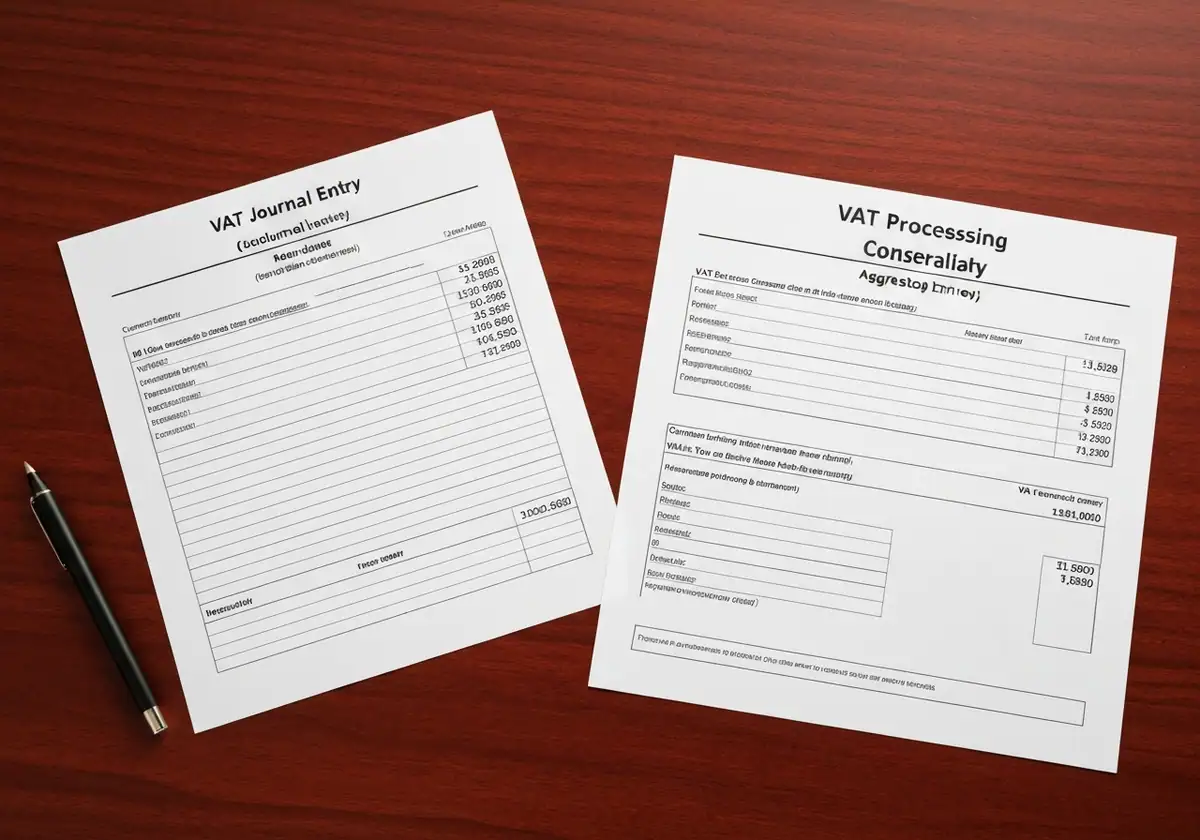
A VAT journal entry is the accounting record used to capture the tax component of any taxable transaction — whether that transaction involves buying goods, selling services, or settling a tax liability with the authority. The journal entry separates the base value of the transaction from the tax portion, ensuring that each element sits in the correct account on the general ledger. Without this separation, a company cannot accurately measure how much tax it owes, how much it can recover, or whether it is on track before the VAT payment deadline arrives.
What’s interesting here is that most accounting errors don’t come from ignorance of the rules — they come from inconsistent application. A business might handle its purchase journal entry correctly for months and then slip up during a busy period, mixing net and gross figures. That single inconsistency can distort an entire VAT return. The structure of the journal entry system exists precisely to prevent that kind of drift.
Input VAT Entry (on Purchases)
- Debit the purchases or expense account with the net amount before tax.
- Debit the input VAT account with the tax amount calculated at the applicable rate.
- Credit the accounts payable or cash account with the full gross amount paid.
- This purchase journal entry ensures the tax paid on inputs is held separately and available for offset against output tax.
- If the supplier issues a corrected invoice later, a reversing entry must be posted to keep the records clean.
Output VAT Entry (on Sales)
- Debit the accounts receivable or cash account with the full gross amount charged to the customer.
- Credit the revenue or sales account with the net amount before tax.
- Credit the output VAT account with the tax collected on behalf of the authority.
- This sales journal entry confirms that the business has collected the tax and holds it as a liability until it is remitted.
- Any credit notes issued to customers require a corresponding reversal of the original sales journal entry.
VAT Settlement Entry (Tax Return Filing)
- Compare the total balance in the output VAT account against the total balance in the input VAT account for the period.
- If output VAT exceeds input VAT, debit the output VAT account and credit the VAT payable account for the net amount owed.
- If input VAT exceeds output VAT, debit the VAT refund receivable account and credit the input VAT account for the surplus.
- Post the settlement entry at period-end before preparing the VAT return to ensure both accounts are cleared correctly.
- Retain all supporting invoices and documents referenced by these entries for the mandatory audit retention period.
VAT Refund Entry (Recovering Tax from the Authority)
- Once the authority approves a refund claim, debit the cash or bank account with the refund amount received.
- Credit the VAT refund receivable account to close out the asset previously recognized.
- If the refund is only partially approved, post the difference to an expense account or carry it forward based on the authority’s determination.
- Document the approval reference number in the journal entry description for traceability.
- Reconcile the refund receivable account after every filing cycle to avoid carrying stale balances.
The Importance of Recording VAT Journal Entries
- Accurate VAT journal entries form the backbone of every VAT return submitted to the authority — errors in the ledger translate directly into errors in the filing.
- Proper recording makes it straightforward to meet the VAT payment deadline without last-minute scrambling, because the payable figure is always visible in the accounts.
- Businesses that record consistently are far better positioned during tax audits, since every transaction is supported by a matching journal entry and source document.
- The discipline of maintaining clean records also reveals patterns — unusually high input VAT in a period, for example, might indicate a processing error or a duplicate purchase journal entry.
- Regulatory changes, including any future VAT increase, are easier to absorb when the accounting structure is already sound, because rate adjustments only require updating a parameter rather than rebuilding a broken system.
- For businesses working toward external investment or financing, audited accounts with clean VAT records signal financial maturity and reduce due-diligence risk.
- OMK’s certified public accounting team helps clients build these habits from day one not as a corrective measure, but as a structural advantage.
The Difference Between a VAT Journal Entry and VAT Processing Entries

- A VAT journal entry is the individual accounting record for a single taxable event — one invoice, one purchase, one credit note.
- VAT processing entries refer to the broader set of period-end adjustments: settlement entries, reclassifications, refund accruals, and return reconciliations.
- The sales journal entry sits within the first category; it records what happened at the point of the transaction.
- Period-end processing, by contrast, looks across all transactions in aggregate and produces the figures that feed into the official VAT return.
- Confusing the two is a common source of double-counting — recording a settlement entry on top of the original transaction entries without netting them off properly.
- Both categories must be handled with equal care; a perfect set of transaction-level entries can still produce a wrong VAT return if the processing entries are flawed.
- OMK’s certified public accounting professionals treat these as two distinct but connected workflows, reviewing each independently before signing off on a filing.
VAT Processing Stages
VAT processing is not a single event — it is a cycle that repeats every tax period, and each phase builds on the one before it. Think of it as a relay race where dropping the baton at any stage means the whole effort fails. The cycle begins the moment a taxable transaction occurs and ends only when the authority has confirmed receipt of the return and any payment due.
Here’s the thing most businesses underestimate: the quality of the final VAT return is almost entirely determined by what happens in the first stage. If the transaction-level entries are clean and complete, the rest of the process is largely mechanical. If they are not, every subsequent stage becomes an exercise in damage control.
Recording VAT on Inputs and Outputs
- Post every purchase journal entry and sales journal entry on the same day the transaction occurs, not at period-end.
- Reconcile supplier invoices against purchase orders before posting to avoid recording unverified input VAT.
- Flag any transactions where the tax rate applied differs from the standard rate, as these require separate account codes.
- Maintain a running total of both input and output VAT accounts so the net position is visible at any point during the period.
Preparing the VAT Return and Reconciling the Tax Difference
- Extract the closing balances from the input and output VAT accounts and compare them to the transaction listings generated from the accounting system.
- Identify and investigate any discrepancies between the ledger totals and the transaction listings before filing.
- Calculate the net VAT position — payable or refundable — and post the settlement journal entry to clear both VAT accounts.
- Verify that the VAT payment deadline for the current period is noted and that a payment instruction is scheduled if a liability exists.
Recovering VAT When Inputs Exceed Outputs
- Prepare a formal refund claim supported by copies of all relevant purchase invoices and import documents.
- Post a VAT refund receivable entry in the accounts to recognize the asset pending authority approval.
- Monitor the claim status and follow up within the timeframes permitted under the regulations.
- Upon receiving the refund, post the cash receipt entry and close the receivable account — keeping the net effect on the VAT accounts at zero.
Why You Need a Certified Public Accountant for VAT Entries and Processing

VAT accounting looks manageable in a spreadsheet — right up until the first audit notice arrives. The rules around which transactions are taxable, which are exempt, and how to handle cross-border supplies are detailed enough that even experienced bookkeepers can make consequential mistakes without realizing it. A certified public accountant brings not just technical knowledge but also professional accountability: they are licensed, regulated, and answerable for the advice they give.
Most people overlook the risk embedded in the VAT payment deadline. Missing it is not just a financial penalty — it creates a compliance record that can affect how the authority treats every future interaction with the business. An accountant tracks these deadlines as a matter of professional discipline, not an afterthought.
OMK operates as a full-service certified public accounting firm with deep experience in VAT registration, return preparation, audit support, and the kind of ongoing ledger maintenance that keeps clients clean through every filing cycle. The team understands that VAT is not a once-a-year event — it lives in every invoice, every payment, every refund claim. When a VAT increase is announced or regulations are amended, OMK clients are notified proactively and their systems are updated before the effective date, not after.
There is a real difference between having accounts that are technically filed and having accounts that are genuinely accurate. OMK is built around the second standard.
Frequently Asked Questions
What is the difference between input VAT and output VAT in journal entries?
Input VAT is the tax a business pays on its purchases — recorded as a debit on the purchase journal entry and held as a recoverable asset. Output VAT is the tax a business collects from its customers on sales — recorded as a credit on the sales journal entry and held as a liability until remitted. When preparing the VAT return, the two are netted: if output exceeds input, the difference is paid to the authority; if input exceeds output, the business may claim a refund. Keeping these two accounts separate and reconciled is the foundation of accurate VAT journal entries.
What happens if a company misses the VAT payment deadline?
Missing the VAT payment deadline typically triggers late payment penalties calculated as a percentage of the outstanding amount, applied on a daily or monthly basis depending on the jurisdiction’s regulations. Beyond the financial cost, repeated late payments can attract heightened scrutiny from the tax authority and complicate future refund claims. The best mitigation is a proactive accounting calendar — maintained by a certified public accountant — that flags the deadline well in advance and ensures the settlement journal entry and payment instruction are ready before the due date.
Do small businesses need a certified public accountant for VAT entries?
Size does not reduce the legal obligation to file accurate VAT returns — it just reduces the volume of transactions involved. Small businesses are, if anything, more vulnerable to compliance errors because they typically lack dedicated finance teams to catch mistakes before they become problems. Working with a certified public accounting firm like OMK gives small businesses access to professional-grade accuracy without the cost of a full-time hire. The investment is consistently smaller than the penalties and corrective work that follow a poorly maintained set of VAT records.
Getting VAT journal entries right is not about following a checklist — it is about building a habit of precision that protects the business at every filing, every audit, and every regulatory change. From the first purchase journal entry of the year to the final settlement before the VAT payment deadline, every record matters. OMK’s certified public accounting team is ready to help your business handle VAT journal entries with the accuracy and consistency they demand reach out today and put the right expertise behind your accounts.