

Understanding how to calculate an income statement is one of the most valuable financial skills any business owner or accountant can develop. The income statement is not just a regulatory formality it is a living snapshot of financial performance over a defined period, telling you exactly where money came from and where it went. Get this right, and you get a clear picture of profitability that drives every important business decision.
At OMK, a trusted certified public accounting office, helping clients master financial reporting is a core part of the service. Whether you are running a startup or managing an established enterprise, learning how to calculate an income statement correctly gives you a serious competitive edge and helps you avoid the costly mistakes that come from working with incomplete or misread financial data.
What Is an Income Statement?
The income statement — sometimes called the profit and loss statement — is a formal financial document that summarizes a company’s revenues, expenses, and resulting net profit or loss during a specific accounting period. That period could be a month, a quarter, or a full fiscal year. Unlike the balance sheet, which captures a company’s position at a single point in time, the income statement tracks performance across a time range.
What’s interesting here is that many people confuse the income statement with a simple revenue report. They are not the same thing. A revenue report only shows money coming in. The income statement goes much further — it accounts for the cost of generating that revenue, the operational expenses involved, taxes, and any non-operating income or losses. The result is a true measure of financial health, not just activity.
The comprehensive income statement takes this a step further by including gains and losses that are not reflected in regular net income, such as unrealized investment gains or foreign currency translation adjustments. For most small and medium businesses, the standard income statement is sufficient, but larger entities and publicly listed companies often rely on the comprehensive income statement to give investors a fuller picture.
The Importance of the Income Statement for Businesses and Individuals
- Measuring profitability — The income statement is the primary tool for determining whether a business is actually making money after all costs are accounted for, not just generating revenue on paper.
- Securing financing — Banks and investors consistently request a well-prepared income statement before approving loans or making investment decisions. It signals financial credibility.
- Tax compliance — Tax authorities require accurate income statements to calculate tax liabilities correctly. Errors here can trigger audits or penalties.
- Internal performance tracking — Comparing income statements across periods reveals trends — whether costs are creeping up, whether revenue is growing consistently, or whether a specific product line is underperforming.
- Supporting strategic decisions — Expanding into a new market, hiring additional staff, or cutting a service line all become easier decisions when you have clear income data to reference.
- Personal financial planning — Individuals who run freelance operations or side businesses can use a simplified income statement template to track earnings and expenses, identify tax deductions, and set savings targets.
Core Components of an Income Statement

- Revenue (Net Sales) — The total income generated from selling goods or services before any deductions, also called the top line.
- Cost of Goods Sold (COGS) — The direct costs tied to producing what was sold, including raw materials and direct labor.
- Gross Profit — Revenue minus COGS. This tells you how efficiently the core business operation runs.
- Operating Expenses — Costs not directly tied to production, such as rent, salaries, utilities, and marketing.
- Operating Income (EBIT) — Gross profit minus operating expenses. Earnings before interest and taxes.
- Non-Operating Items — Interest income, interest expense, and any gains or losses from investments or asset sales.
- Pre-Tax Income — Operating income adjusted for non-operating items.
- Income Tax Expense — The tax owed based on pre-tax income, calculated according to the applicable tax rate.
- Net Income — The bottom line. What remains after every expense and tax obligation has been subtracted from total revenue.
The Basic Formula for Calculating an Income Statement
The fundamental formula behind the income statement is straightforward, even if the details can get complex: Net Income = Total Revenue − Total Expenses. Every line item on the statement feeds into either the revenue or the expense side of this equation, and the goal is always to arrive at an accurate net figure.
Here’s the thing — the formula sounds simple, but applying it correctly requires a solid understanding of what belongs in each category. For example, depreciation is an expense even though no cash changes hands. Returned goods reduce reported revenue. Discounts given to customers at the point of sale must be deducted before you record net revenue. These distinctions matter enormously.
OMK’s certified public accounting office works with businesses across industries to ensure their income statement calculations follow both local accounting standards and international financial reporting frameworks. A correctly structured income statement template not only satisfies auditors but also gives management the clarity they need to act on the numbers rather than guess at them.
The comprehensive income statement adds an additional layer to this formula by capturing other comprehensive income items — elements that affect equity but bypass the traditional net income calculation. Businesses that deal in foreign currencies, hold available-for-sale securities, or carry pension obligations will encounter these items regularly.
Steps for Calculating Gross Income
- Identify the accounting period — Define the start and end date of the period you are reporting on. This could be monthly, quarterly, or annual.
- Total all revenue sources — Add up every stream of income: product sales, service fees, licensing income, and any other revenue-generating activity.
- Calculate returns and allowances — Subtract any refunds issued, discounts applied, and allowances granted to arrive at net revenue.
- Determine the cost of goods sold — Add beginning inventory to purchases made during the period, then subtract ending inventory. This gives you COGS.
- Subtract COGS from net revenue — The result is your gross profit. This is the first major milestone in building a complete income statement.
- Verify the figures against source documents — Cross-reference invoices, receipts, and payroll records to confirm every number is accurate before moving to the next stage.
Types of Income Statements
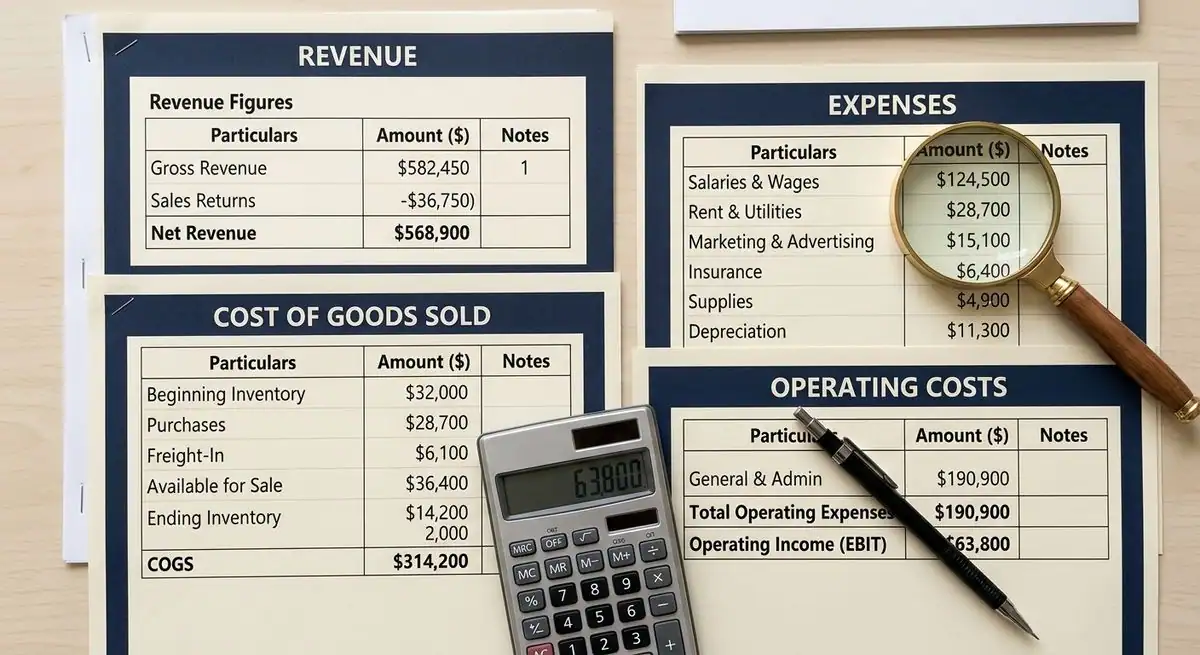
Not every income statement looks the same. The format a business chooses depends on its size, the complexity of its operations, and what its stakeholders need to see. There are two widely recognized formats used in practice.
Single-Step Income Statement
- Combines all revenues into one total and all expenses into one total, then subtracts to find net income.
- Best suited for small businesses, sole proprietors, and freelancers with straightforward finances.
- Easier and faster to prepare, making it ideal for internal monthly reviews.
- Provides less detail about operating versus non-operating performance.
- Often used as a starting point when learning how to calculate an income statement for the first time.
Multi-Step Income Statement
- Separates operating revenues and expenses from non-operating ones, producing intermediate figures like gross profit and operating income.
- Required by most regulatory bodies for medium and large companies.
- Gives investors, lenders, and analysts a much more nuanced view of where profitability is coming from.
- Directly connects to the comprehensive income statement framework used in full financial reporting packages.
- Preferred by OMK’s accounting professionals when preparing reports for audit or investor presentation purposes.
Important Tips When Calculating an Income Statement
- Always use the accrual basis of accounting — Record revenue when it is earned and expenses when they are incurred, not when cash physically moves. This is the standard under most accounting frameworks.
- Keep revenue and capital items strictly separate — Mixing operating revenue with the proceeds from selling an asset is a common error that distorts the income statement entirely.
- Reconcile every figure with bank statements — Especially for small businesses, it is easy for figures to drift. Monthly reconciliation prevents compounding errors.
- Use a consistent income statement template — Changing formats between periods makes comparison nearly impossible. Standardize early and stick with it.
- Account for depreciation properly — Assets that lose value over time must have that depreciation recorded as an expense each period, even if no cash was spent.
- Get a professional review — At least once a year, having a certified accountant like those at OMK review your income statements catches errors that internal teams often miss.
Common Mistakes When Calculating an Income Statement
- Omitting non-cash expenses — Forgetting to include depreciation, amortization, or stock-based compensation inflates reported income and creates a misleading picture.
- Recording revenue before it is earned — Counting payment received in advance as current revenue violates the matching principle and overstates performance.
- Misclassifying expenses — Placing a capital expenditure into operating expenses, or vice versa, distorts both the income statement and the balance sheet simultaneously.
- Ignoring tax provisions — Skipping the income tax expense line or estimating it carelessly leads to significant discrepancies when actual tax filings are prepared.
- Failing to separate owner’s salary from profit — In owner-operated businesses, the owner’s draw is sometimes excluded from expenses, which artificially inflates net income.
- Using inconsistent accounting periods — Comparing a twelve-month income statement with a nine-month one without adjustment produces meaningless trend data.
How to Use the Income Statement in Decision-Making
- Pricing strategy — Gross profit margins revealed by the income statement show whether current pricing covers costs and leaves acceptable profit. If margins are thin, prices may need adjustment.
- Cost control — A detailed breakdown of operating expenses highlights where spending is rising faster than revenue, flagging areas that need tighter management.
- Expansion planning — Before committing to new locations, hires, or product lines, comparing projected income statements against historical ones reveals whether the business can sustain the added cost.
- Investor communication — A clean, professionally prepared income statement is often the first document an investor asks for. It frames the entire conversation about business value.
- Budgeting for the next period — Last period’s income statement becomes the baseline for next period’s budget, making accurate historical data essential.
- Benchmarking against industry peers — Knowing your net income margin relative to industry averages tells you whether the business is performing at, above, or below the standard for your sector.
Frequently Asked Questions
What is the difference between a single-step and a multi-step income statement?
The single-step income statement adds up all revenues, subtracts all expenses in one calculation, and arrives at net income. It is simple and works well for smaller operations. The multi-step income statement breaks the process into stages — calculating gross profit first, then operating income, then net income — which gives a far richer view of where the business is earning and losing. Most accountants and financial analysts prefer the multi-step format for anything beyond the most basic business structure.
How often should a business prepare an income statement?
At minimum, businesses should prepare an income statement quarterly, but monthly reporting is strongly recommended. Monthly income statements allow management to catch problems early — a dip in gross margin or a spike in operating costs becomes visible within weeks rather than months. Annual income statements are mandatory for tax and regulatory purposes, but relying only on annual figures means reacting to problems long after they have already caused damage.
Can individuals use an income statement for personal financial planning?
Absolutely — and this is something most people overlook entirely. Knowing how to calculate an income statement does not have to stay in the corporate world. A simplified personal income statement that lists all income sources and all monthly expenses gives you the same clarity about your personal finances that businesses get about their operations. It is especially useful for freelancers, investors, and anyone running a side business who needs to track profitability and prepare accurate tax returns.
Mastering how to calculate an income statement is not a skill reserved for accountants alone — it is something every business owner, manager, and financially aware individual benefits from deeply understanding. From identifying your revenue streams to tracking expenses and arriving at a true net income figure, the income statement template gives structure to what would otherwise be a confusing mass of financial data. The insights it provides — when read correctly — power better pricing, smarter hiring, and more confident growth decisions. If you want your financial reporting to be accurate, compliant, and genuinely useful, reach out to OMK’s certified public accounting office today. The team brings the expertise to make your numbers work for you, not against you.