
Understanding how to prepare a balance sheet is one of the most foundational skills in accounting and yet it trips up more people than you’d expect. The balance sheet gives a precise snapshot of a company’s financial position at a specific point in time, showing what the business owns, what it owes, and what remains for its owners. Get it right, and you have a powerful tool. Get it wrong, and every financial decision built on top of it becomes unreliable.
This guide walks through the entire process in plain language, drawing on the kind of practical expertise that OMK, a certified accounting office, applies every day when preparing financial statements for businesses of all sizes. Whether you’re a business owner trying to understand your numbers or an accounting student building your knowledge, what follows is designed to be genuinely useful.
What Is a Balance Sheet

A balance sheet — known in Arabic accounting circles as Balance Sheet which translates directly to the “financial position statement” — is one of the three core financial statements every entity must produce. Unlike a profit-and-loss report, which covers a period of time, the balance sheet captures a single moment: what the company looked like financially on one specific date. Think of it as a photograph rather than a film.
The fundamental equation governing every balance sheet is simple: Assets = Liabilities + Equity. Everything on the left side of the ledger must equal everything on the right. That balance is not a coincidence — it is the direct result of double-entry bookkeeping. If the two sides don’t match, something has been recorded incorrectly, and that discrepancy needs to be found and corrected before the statement means anything.
What makes the balance sheet especially powerful is context. A single balance sheet tells you something. Two balance sheets from consecutive periods tell you a story. Analysts, lenders, and investors read changes between periods to understand whether a business is growing, stagnating, or quietly deteriorating — often before management notices the same thing.
Components and Elements of a Balance Sheet
- Current Assets: Cash and cash equivalents, short-term investments, accounts receivable, inventory, and prepaid expenses — anything expected to be converted into cash within twelve months.
- Non-Current Assets: Long-term investments, property, plant and equipment (net of accumulated depreciation), intangible assets such as patents and goodwill, and right-of-use assets under lease agreements.
- Current Liabilities: Accounts payable, short-term loans, accrued expenses, deferred revenue, and the current portion of long-term debt — obligations due within the next twelve months.
- Non-Current Liabilities: Long-term bank loans, bonds payable, deferred tax liabilities, and pension obligations — amounts not due for repayment within one year.
- Equity: Paid-in share capital, retained earnings, treasury shares (as a deduction), and any other comprehensive income components accumulated over time.
- Minority Interest (if applicable): In consolidated financial statements, the portion of equity in subsidiaries not attributable to the parent company is reported separately within the equity section.
What Account Does Not Appear on a Balance Sheet?
Here’s the thing — this question comes up constantly, and the answer is simpler than most people assume. Revenue and expense accounts do not appear on the balance sheet. They belong to the income statement (or the comprehensive income statement when other comprehensive income items are included). Once an accounting period closes, these accounts are zeroed out through closing entries, and their net result flows into retained earnings within the equity section of the balance sheet.
Accounts like Sales Revenue, Cost of Goods Sold, Depreciation Expense, and Interest Expense are temporary accounts. They exist only for one accounting cycle. Permanent accounts — assets, liabilities, and equity — carry forward their balances indefinitely, and those are the ones you see when you look at a balance sheet.
Most people overlook another category worth mentioning: contingent liabilities that do not meet the recognition threshold. If a lawsuit is possible but not probable, or its financial impact cannot be reliably measured, it stays off the balance sheet and appears only as a note disclosure. Same goes for operating leases under older standards that have since been superseded by IFRS 16.
Importance and Uses of a Balance Sheet
- Creditworthiness Assessment: Banks and lenders study the balance sheet to evaluate whether a business has sufficient assets to cover its debts before approving loans or credit facilities.
- Liquidity Analysis: Ratios like the current ratio and quick ratio, both derived from balance sheet figures, tell stakeholders whether the company can meet short-term obligations without stress.
- Investment Decision-Making: Equity investors look at book value, debt-to-equity ratios, and working capital trends to judge whether a company represents a sound investment.
- Internal Planning: Management uses the balance sheet to identify underused assets, excessive debt levels, or cash shortfalls that need addressing before they become crises.
- Regulatory Compliance: Many jurisdictions require audited balance sheets as part of annual filings. Accurate preparation keeps the company on the right side of regulators and tax authorities.
- Mergers and Acquisitions: During due diligence, acquirers scrutinize the target company’s balance sheet to understand what they’re actually buying — and what hidden liabilities might come with it.
- Benchmarking: Comparing your balance sheet against industry averages reveals whether your capital structure, asset base, and leverage are in line with competitors or outliers.
How Do You Read a Balance Sheet?
- Start with total assets: This tells you the scale of the business. A large asset base doesn’t automatically mean a healthy business — it depends entirely on how those assets are financed.
- Split assets into current and non-current: Heavy non-current assets suggest a capital-intensive business; high current assets suggest a trading or service business with faster cash cycles.
- Examine the liability side carefully: Look at the ratio of current to long-term debt. A company relying heavily on short-term borrowing to fund long-term assets is carrying maturity mismatch risk.
- Calculate the current ratio: Divide current assets by current liabilities. Anything below 1.0 signals potential liquidity trouble. Above 2.0 may suggest idle cash that could be deployed more productively.
- Check equity trends: Growing retained earnings over multiple periods signal profitability and reinvestment. Shrinking equity — especially into negative territory — is a serious warning sign.
- Read the notes: The balance sheet figures alone are never the full picture. Notes disclose accounting policies, contingencies, related-party transactions, and much more.
Who Is Responsible for Preparing a Balance Sheet?
Responsibility for preparing a balance sheet sits primarily with the company’s finance and accounting team, led by the Chief Financial Officer or Financial Controller. In smaller businesses without dedicated finance staff, this role often falls to an external certified accountant — which is precisely where a firm like OMK, operating as a licensed certified accounting office, adds immediate value.
What’s interesting here is how the responsibility chain actually works in practice. Management is responsible for the preparation and fair presentation of financial statements. External auditors are responsible for expressing an independent opinion on whether those statements give a true and fair view. The two roles are distinct and should never be confused. An auditor who also prepares the statements they audit faces an independence conflict under virtually every professional standard.
For companies subject to statutory audit requirements, the balance sheet must be signed off by the board and then examined by an independent auditor. For smaller entities, a compilation or review by a qualified professional such as those at OMK may be sufficient — but the underlying responsibility for accuracy always rests with management.
How to Prepare a Balance Sheet
Learning how to prepare a balance sheet properly means following a clear, sequential process. Skipping steps leads to imbalanced statements and wasted time hunting for errors.
- Close the accounting period: Ensure all transactions up to the reporting date have been recorded, all accruals posted, and all prepayments adjusted.
- Run a trial balance: Extract a complete list of all account balances. This is your raw material for all the financial statements, including the balance sheet.
- Classify accounts correctly: Separate assets from liabilities and equity. Within assets and liabilities, distinguish between current and non-current based on the twelve-month rule.
- Calculate totals for each section: Sum current assets, then non-current assets to get total assets. Do the same for current liabilities, non-current liabilities, and equity components.
- Verify the fundamental equation: Total assets must equal total liabilities plus equity. If they don’t, trace back through your classifications and arithmetic to find the error.
- Add comparative figures: Best practice — and a requirement under IFRS — is to show at least one prior period alongside the current period for meaningful comparison.
- Attach supporting notes: The balance sheet is incomplete without notes disclosing significant accounting policies, breakdowns of major line items, and any relevant contingencies.
- Have the statement reviewed: Before finalizing, have a qualified professional — ideally a certified accountant like those at OMK — review the statement for accuracy and compliance.
What Is the Difference Between a Balance Sheet and a Budget?
- Nature: A balance sheet reports actual financial position at a specific date. A budget is a forward-looking plan showing projected revenues, expenses, and financial targets.
- Time orientation: The balance sheet is historical. The budget is future-focused.
- Purpose: The balance sheet is used for reporting, analysis, and compliance. The budget is used for planning, performance management, and resource allocation.
- Legal standing: A balance sheet is a formal financial statement required by law in most jurisdictions. A budget is an internal management tool with no mandatory legal format.
- Accuracy: Balance sheet figures are based on actual recorded transactions. Budget figures are estimates that may or may not reflect reality.
- Audience: The balance sheet is shared with external stakeholders — banks, investors, regulators. Budgets are typically internal documents used by management teams.
The Difference Between an Income Statement and a Balance Sheet
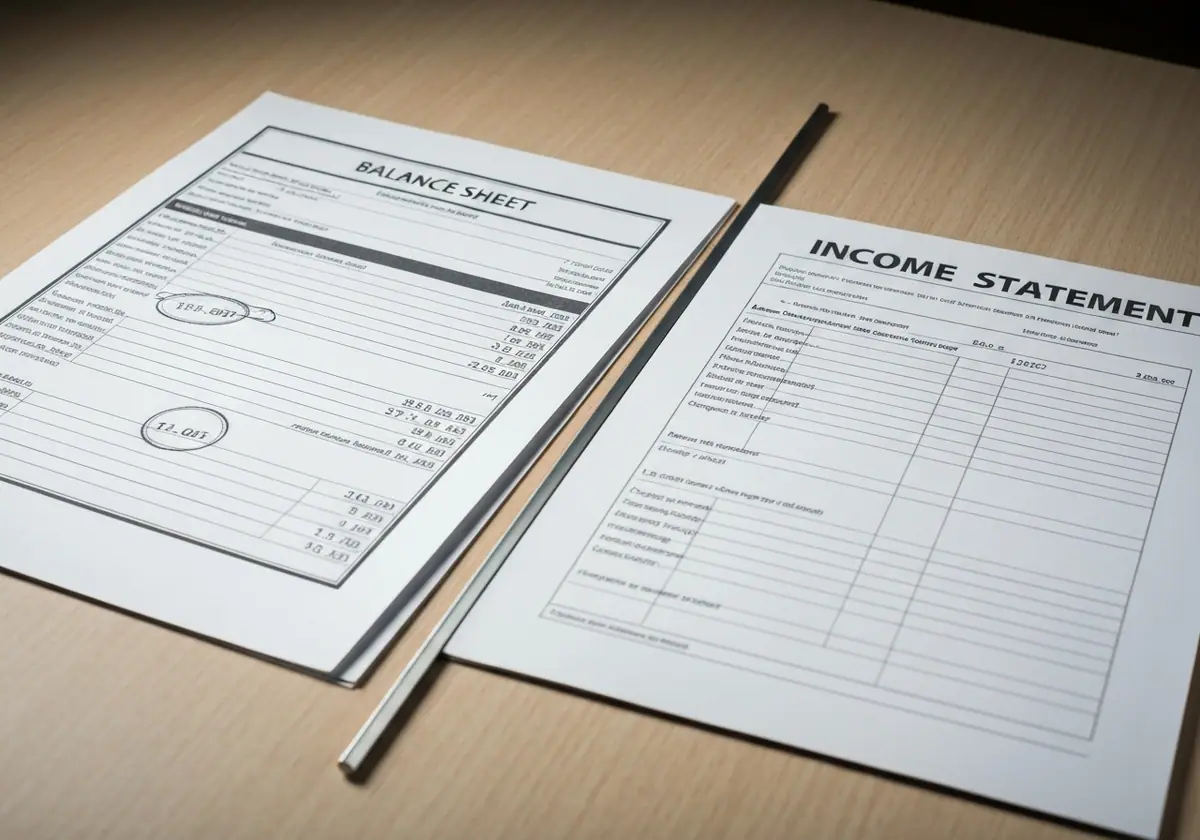
- What it covers: The income statement (or comprehensive income statement) covers revenues, expenses, and profits over a period of time. The balance sheet captures the financial position at a single point in time.
- Key outputs: The income statement produces net profit or loss. The balance sheet produces total assets, total liabilities, and equity.
- Connection between the two: Net profit from the income statement flows into retained earnings on the balance sheet — this is how the two statements are linked.
- Items included: The income statement includes sales, cost of goods sold, operating expenses, interest, and tax. The balance sheet includes cash, receivables, inventory, payables, loans, and capital.
- Reading frequency: Income statements are often reviewed monthly or quarterly for performance tracking. Balance sheets are typically reviewed at period-end for position assessment.
- Temporary vs. permanent accounts: Income statement accounts reset to zero each period. Balance sheet accounts carry forward their balances indefinitely.
How Is a Balance Sheet Presented According to the IFRS Accounting Standard?
Under International Financial Reporting Standards (IFRS), specifically IAS 1 — Presentation of Financial Statements, the balance sheet (formally called the Statement of Financial Position) must meet several specific requirements. The standard does not prescribe a fixed format, but it mandates certain minimum line items that must appear on the face of the statement.
Required line items under IAS 1 include property, plant and equipment; investment property; intangible assets; financial assets; deferred tax assets and liabilities; inventories; trade and other receivables; cash and cash equivalents; trade and other payables; provisions; issued capital and reserves. Any additional items, headings, or subtotals should be presented when doing so is relevant to an understanding of the entity’s financial position.
Preparing financial statements under IFRS also requires entities to present assets and liabilities separately as current and non-current unless a liquidity-based presentation provides more reliable and relevant information — which is sometimes the case for financial institutions. Companies must also present at least two balance sheets (current period and comparative prior period) and a third if they apply an accounting policy retrospectively with a material effect.
What Is the Difference Between a Trial Balance and a Balance Sheet?
- Definition: A trial balance is an internal working document listing all ledger account balances to verify that debits equal credits. A balance sheet is a formal external financial statement.
- Purpose: The trial balance is a bookkeeping check. The balance sheet is a management and reporting tool used by external stakeholders.
- Content: The trial balance includes every single account — including revenue, expense, and drawing accounts. The balance sheet includes only permanent accounts: assets, liabilities, and equity.
- Format: The trial balance has two columns — debit and credit. The balance sheet is structured around the accounting equation: Assets = Liabilities + Equity.
- Audience: The trial balance is used internally by accountants during the closing process. The balance sheet is shared with investors, banks, auditors, and regulatory bodies.
- IFRS compliance: The trial balance has no required format and is purely a working paper. The balance sheet must comply with applicable accounting standards such as IFRS or local GAAP.
Frequently Asked Questions
What is the correct order of items on a balance sheet?
Assets are typically presented in order of liquidity — from the most liquid (cash) to the least liquid (long-term assets like property). Liabilities follow the same logic, starting with those due soonest (current liabilities) and moving to long-term obligations. Equity appears at the bottom, with share capital listed before retained earnings in most formats. Following this order makes the statement easier to read and analyze, and it aligns with the expectations of banks, auditors, and investors.
Can a small business prepare its own balance sheet?
Technically, yes — but practically, the risks of doing it without professional guidance are significant. Misclassifying assets and liabilities, applying the wrong depreciation method, or omitting accruals can render the balance sheet meaningless or even misleading. Understanding how to prepare a balance sheet correctly requires both accounting knowledge and familiarity with applicable standards. OMK’s certified accounting office works regularly with small and medium-sized businesses to ensure their financial statements are accurate, compliant, and genuinely useful for decision-making — not just a box-ticking exercise.
How often should a balance sheet be prepared?
At minimum, a balance sheet should be prepared annually for statutory and tax purposes. Most businesses benefit from monthly or quarterly balance sheets for internal management — catching cash flow issues, tracking debt levels, and monitoring working capital in real time. High-growth companies and those with external investors often need monthly financial reporting as a condition of their funding arrangements. The frequency ultimately depends on the size of the business, its reporting obligations, and how actively management wants to monitor financial health.
Mastering how to prepare a balance sheet is not a one-time task — it is an ongoing discipline that sits at the heart of sound financial management. Every lender who reviews your loan application, every investor who evaluates your business, and every regulator who examines your filings will look at this document first. Getting it right matters enormously. The good news is that with the right process — closing accounts properly, classifying items correctly, verifying the equation, and presenting in line with IFRS — the balance sheet becomes a reliable, readable, and genuinely powerful tool. If you want professional support with preparing financial statements, OMK’s certified accounting office brings the expertise, the standards knowledge, and the practical experience to get it done properly. Reach out to OMK and let a real accounting professional take care of it.