
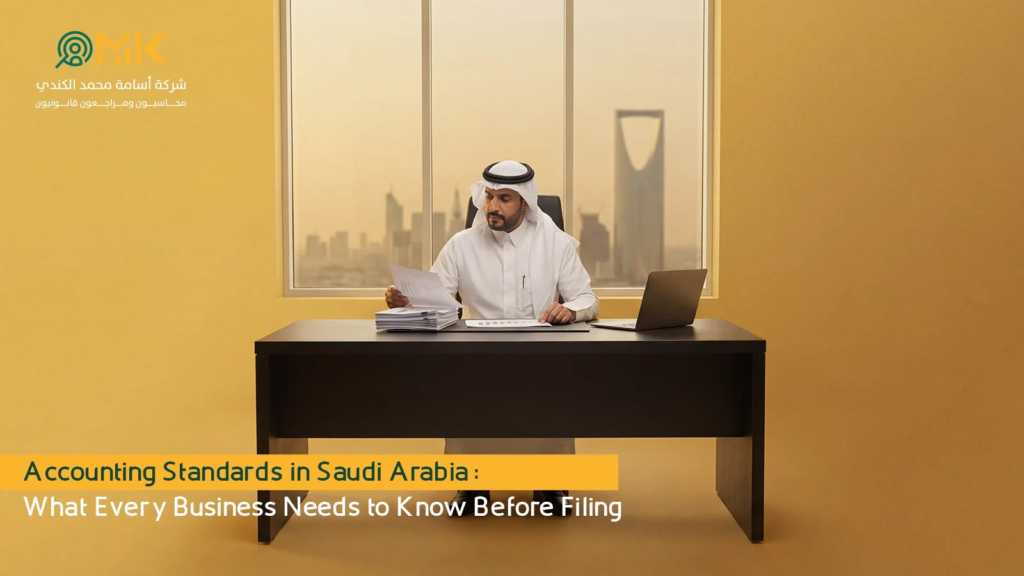
Understanding accounting standards in Saudi Arabia is no longer a concern reserved for finance teams and auditors. As the Kingdom accelerates its economic transformation under Vision 2030, compliance with recognized financial reporting frameworks has become a strategic priority for every business operating in the Saudi market; from early-stage startups to listed corporations.
This guide explains the structure of Saudi accounting standards, their relationship with international frameworks, and what compliance means in practical terms for your business.
What Are Accounting Standards and Why Do They Matter?
Accounting standards are structured rules and principles that govern how financial transactions are recorded, measured, and reported. Their purpose is to create a common financial language; one that allows investors, lenders, regulators, and management to read and compare financial statements with confidence, regardless of where a company operates.
Without shared standards, a company might report a profit under one set of rules and a loss under another. Comparability breaks down, and trust erodes. The push toward internationally aligned accounting standards is therefore not merely regulatory; it is foundational to any economy seeking foreign investment and sustainable growth.
The Regulatory Framework: Who Governs Accounting Standards in Saudi Arabia?
Several institutions share responsibility for developing and enforcing the accounting framework in the Kingdom:
The Saudi Organization for Chartered and Professional Accountants (SOCPA)
is the primary standard-setting body for the private sector. SOCPA develops and oversees Saudi Accounting Standards, accredits certified public accountants, and aligns local standards with international frameworks. SOCPA launched its IFRS transition project in 2012, and mandatory adoption for listed companies took effect in 2017.
The Capital Market Authority (CMA)
enforces financial reporting obligations for companies listed on Tadawul, requiring adherence to IFRS and detailed disclosure standards to protect investors.
The Saudi Central Bank (SAMA)
issues governance and reporting instructions for the financial and banking sector, including internal audit requirements.
The Ministry of Finance
oversees accounting standards for the public sector. Following a Royal Decree in 2016, all government entities are transitioning from cash-basis to accrual-basis accounting in line with International Public Sector Accounting Standards (IPSAS). The fourth edition of Saudi Public Sector Accounting Standards was approved in July 2025, now covering 44 topics including a conceptual framework, 40 standards, and three recommended guidelines — adapted from IPSAS to reflect the Kingdom’s regulatory environment.
International Accounting Standards vs. IFRS: Understanding the Distinction
A common source of confusion is the relationship between International Accounting Standards (IAS) and International Financial Reporting Standards (IFRS). The distinction matters because both sets of standards remain in active use.
IAS were developed by the International Accounting Standards Committee (IASC) beginning in 1973, with the goal of reducing inconsistency in financial reporting across borders. When the International Accounting Standards Board (IASB) — headquartered in London — replaced the IASC in 2001, it began issuing standards under the IFRS label. IFRS represents the updated and expanded successor to IAS, not a replacement of it: many original IAS standards remain in force unless a specific IFRS standard has superseded them.
Both IAS and IFRS are currently applied side by side in Saudi Arabia and across approximately 160 jurisdictions worldwide. The key conceptual difference from US GAAP – the framework used in the United States – is that IFRS operates on a principles-based approach, granting professional judgement greater weight, whereas US GAAP prescribes more detailed rules for specific scenarios. Saudi Arabia follows IFRS rather than US GAAP.
How IFRS Adoption Has Reshaped Saudi Accounting Standards
Saudi Arabia’s decision to align its standards with IFRS has had measurable consequences for how businesses operate and report.
Financial statements prepared under IFRS are now legible to investors in New York, London, and Riyadh without the need for reconciliation or restatement. This comparability has directly supported the Kingdom’s credit ratings and its ability to attract foreign capital. Concepts that previously operated differently under local rules; revenue recognition, lease accounting, financial instruments classification; now follow internationally recognized treatment.
For companies, the transition created both challenges and opportunities. The cost of alignment was real: training, system upgrades, updated policies. But the strategic benefit was equally real: credibility with international lenders and partners who could now read and rely on Saudi financial statements.
Key Accounting Standards Every Saudi Business Should Know

Several specific standards carry practical weight for businesses operating in the Kingdom:
IFRS 15 (Revenue from Contracts with Customers)
governs when and how revenue is recognized. It requires companies to reflect the value of goods or services transferred to customers accurately; a significant shift for sectors with long-term contracts, such as construction and professional services.
IFRS 16 (Leases)
requires most leases to be recognized on the balance sheet, eliminating the off-balance-sheet treatment previously available under older standards. This has implications for companies with significant property or equipment lease portfolios.
IAS 2 (Inventories)
governs inventory valuation. Under IFRS – and therefore under Saudi Accounting Standards – the LIFO method is not permitted. Inventories must be measured using FIFO or weighted average cost.
IAS 36 (Impairment of Assets)
requires companies to test whether the recoverable amount of fixed assets has fallen below their carrying value; an important consideration for capital-intensive businesses.
IAS 12 (Income Taxes)
addresses the accounting treatment for income tax, including deferred tax; a particularly relevant standard given Saudi Arabia’s multi-layer fiscal framework of Zakat, income tax, and VAT.
Compliance, Transparency, and the Role of a Certified Accountant
Compliance with accounting standards is not a passive exercise. It requires ongoing professional judgement, up-to-date knowledge of SOCPA pronouncements, and rigorous internal controls.
The role of a qualified accounting partner is to ensure that financial statements are not merely prepared; but prepared correctly, with disclosures that reflect actual risks and policies, and with filings submitted within regulatory deadlines. For businesses seeking bank financing, submitting Zakat or income tax declarations to ZATCA, or attracting equity investors, the quality of financial statements is a direct reflection of the company’s credibility.
This is where OMK brings meaningful value. As a Riyadh-based firm specializing in accounting, auditing, Zakat, tax, and management consulting, OMK offers the depth of technical knowledge and the familiarity with Saudi regulatory requirements that businesses need to navigate this landscape confidently.
Frequently Asked Questions about Accounting Standards in Saudi Arabia
What accounting standards are currently used in Saudi Arabia?
Private sector companies in Saudi Arabia follow IFRS as adopted by SOCPA. Listed companies have been required to apply IFRS since 2017. Public sector entities are transitioning to IPSAS-aligned standards under the direction of the Ministry of Finance.
Does Zakat compliance affect accounting standards in Saudi Arabia?
Zakat obligations under Saudi law are calculated based on a company’s balance sheet. Accurate financial statements prepared under IFRS directly affect Zakat and income tax calculations. ZATCA – the Zakat, Tax and Customs Authority – relies on compliant financial reporting for assessment and audit purposes.
Are small businesses required to comply with Saudi accounting standards?
All companies operating in Saudi Arabia are subject to accounting and tax obligations. The level of reporting required varies by entity type, size, and sector; but the underlying principle of compliance with recognized standards applies broadly. Consulting a qualified firm is the most reliable way to determine your specific obligations.
What happens if a company does not comply with accounting standards?
Non-compliance can result in penalties from ZATCA, difficulties in renewing commercial licenses, reduced access to bank financing, and exposure during tax audits. Consistent, accurate financial reporting is the most effective risk mitigation strategy available.
Accounting Standards in Saudi Arabia as a Strategic Asset
Compliance with accounting standards in Saudi Arabia is not a cost of doing business; it is an investment in your company’s credibility and long-term sustainability. As Vision 2030 continues to open the Kingdom’s economy to broader investment and competition, the quality of your financial reporting will increasingly determine your ability to access capital, win contracts, and build trust with partners.
Whether you are a growing SME preparing your first audited statements, or an established enterprise aligning with the latest SOCPA updates, having an expert partner ensures your compliance is complete; and your financial position communicated with precision.