In the rapidly evolving economic landscape of Riyadh, businesses are increasingly seeking professional financial clarity to align with Saudi Vision 2030. To manage a successful enterprise, one must fundamentally grasp the difference between auditing and accounting, as these two functions serve as the pillars of financial transparency and organizational growth.
While often used interchangeably in casual conversation, accounting and auditing represent distinct professional disciplines. Understanding how they interact is not just a matter of compliance; it is about building a “Knowledge Authority” that empowers decision-makers to steer their companies toward sustainable success in local and international markets.
What is Accounting? The Language of Business
Before exploring the difference between auditing and accounting, we must define the scope of accounting. Accounting is the continuous process of identifying, recording, measuring, and communicating financial information. It is the “language of business” that tracks every SAR (Saudi Riyal) flowing through an organization.
An accountant’s primary role is to maintain an accurate and up-to-date record of all financial transactions. This includes managing accounts payable and receivable, payroll, and the preparation of essential financial statements such as the Balance Sheet, Income Statement, and Cash Flow Statement. At OMK, we leverage advanced technology to ensure these records are not only compliant with International Financial Reporting Standards (IFRS) but also serve as a real-time dashboard for management.
What is Auditing? The Lens of Verification
If accounting is the process of creating financial records, auditing is the process of verifying them. Auditing involves a meticulous examination of a company’s financial statements by a professional; often an independent third party; to ensure that the records represent a “true and fair view” of the company’s financial position.
In the Saudi context, particularly for licensed firms like OMK, auditing goes beyond simple error-checking. It is a rigorous evaluation of internal controls and compliance with Zakat and tax regulations. The auditor investigates the evidence behind the numbers, ensuring that there are no material misstatements or fraudulent activities.
The Core Difference Between Auditing and Accounting
To help business owners in Riyadh navigate their financial obligations, we have broken down the difference between auditing and accounting into several key dimensions:
1. Timing and Continuity
Accounting is a continuous, daily process. It happens in real-time as transactions occur. Conversely, auditing is typically a periodic activity. While internal audits can happen quarterly, external audits usually occur annually after the financial year ends to validate the final accounts.
2. Primary Objective
The goal of accounting is to provide financial information that is useful for decision-making. The objectives of auditing, however, are focused on verification and credibility. An auditor’s job is to provide an objective opinion on whether the accounting work was done correctly and honestly.
3. Scope of Work
The scope of accounting and auditing differs significantly. Accounting covers all financial transactions within the business. Auditing is more focused; it examines specific samples of data, internal systems, and financial reports to ensure they adhere to legal and professional standards.
4. Professional Status
Accounting is usually performed by internal employees (though it can be outsourced to firms like OMK). Auditing, specifically external auditing, must be performed by a licensed, independent auditor to maintain objectivity and satisfy regulatory requirements in the Kingdom.
Key Objectives of Auditing and Why They Matter
Understanding the objectives of auditing is crucial for any commercial entity aiming for international standards. An audit is not a “trap” for the accounting department; rather, it is a protective measure. The primary objectives include:
- Ensuring Accuracy: Verifying that the figures in the financial statements are supported by actual invoices, receipts, and bank statements.
- Compliance: Ensuring the business follows the Saudi Organization for Chartered and Professional Accountants (SOCPA) standards and IFRS.
- Fraud Detection and Prevention: Identifying weaknesses in the company’s financial systems that could lead to misappropriation of funds.
- Enhancing Credibility: Providing investors, banks, and stakeholders with the confidence that the company’s financial health is reported honestly.
For a firm like OMK, these objectives are the foundation of our “Knowledge Authority”, helping our clients build trust with global partners.
How Accounting and Auditing Work Together
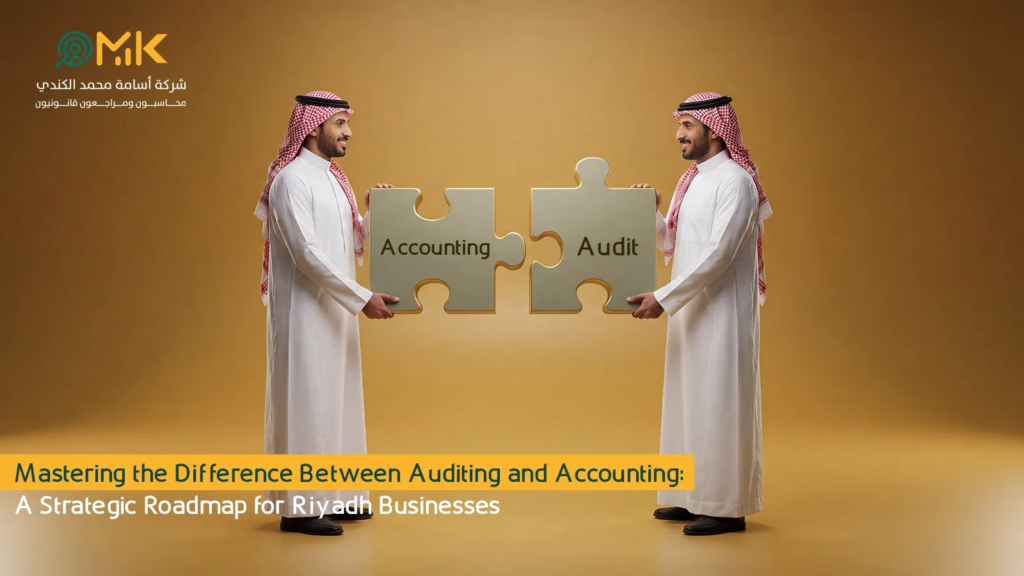
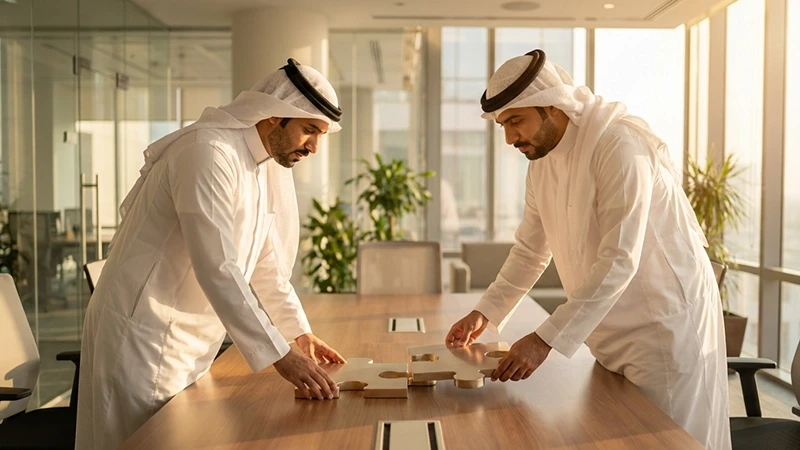
While there is a clear difference between accounting and auditing, they are two sides of the same coin. You cannot have an audit without accounting records to review, and accounting records lack external credibility without an audit.
In Riyadh’s competitive market, integrating accounting and auditing into a single strategic framework allows businesses to minimize risks. For instance, when OMK provides management consultancy, we look at the results of the audit to improve the accounting processes. This synergy ensures that Zakat and tax filings are accurate, reducing the risk of penalties and improving the company’s standing with the Zakat, Tax and Customs Authority (ZATCA).
Navigating the Difference Between Auditing and Accounting with Digital Expertise
As a tech-integrated firm, OMK understands that the modern difference between auditing and accounting is also defined by tools. Modern accounting software automates data entry, but it requires professional accountants to interpret the data. Similarly, modern auditing uses data analytics to scan thousands of transactions for anomalies, something that was impossible a decade ago.
By choosing a professional firm that understands these nuances, companies in Riyadh can move beyond simple bookkeeping. They can transform their financial department into a strategic asset that provides a competitive edge.
Frequently Asked Questions about The Difference Between Auditing and Accounting
Can the same person do both accounting and auditing for a company?
In terms of internal operations, an employee can perform internal audits. However, for official financial statements, the external auditor must be independent and cannot be the same person who prepared the accounts, to avoid a conflict of interest.
Is auditing mandatory for all companies in Riyadh?
Most corporations (JSCs) and limited liability companies (LLCs) in Saudi Arabia are required by the Ministry of Commerce to have their financial statements audited annually by a licensed professional.
Which one happens first, accounting or auditing?
Accounting always comes first. It is the process of creating the records. Auditing is a post-mortem or periodic review that happens after the accounting records are prepared.
How does technology change the difference between accounting and auditing?
Technology automates the “recording” part of accounting, allowing accountants to focus on analysis. For auditing, technology allows for 100% data testing instead of just sampling, making the audit much more accurate and reliable.
Why is the “difference between accounting and auditing” important for Zakat?
Accurate accounting ensures you track your Zakat-base correctly, while a professional audit ensures that your filings to ZATCA are verified, preventing disputes and legal issues.
Making the Right Choice for Your Business
In conclusion, recognizing the difference between auditing and accounting is essential for any business leader. Accounting provides the foundation of data, while auditing provides the seal of truth. Whether you are a local startup or an international corporation operating in Saudi Arabia, maintaining high standards in both areas is non-negotiable for long-term growth.
At OMK, we don’t just provide services; we provide professional experience and technological edge needed to master your financial destiny. By establishing a robust system where accounting and auditing work in harmony, your business can achieve the transparency and authority required to thrive in today’s global economy.
Ready to elevate your financial clarity? Contact our experts at OMK today, to discover how our integrated accounting and auditing solutions can empower your business growth in Riyadh and beyond.