

Every business that takes its finances seriously relies on monthly accounting reports as its backbone — the structured, recurring snapshot that tells management exactly where the money went, where it came from, and what the numbers are actually saying. Without this rhythm, even profitable companies can drift into trouble without realizing it until it’s too late. These reports are not just paperwork; they are a decision-making engine.
Most business owners underestimate how much clarity a well-prepared set of monthly accounting reports can deliver. At OMK, a certified accounting office with deep experience serving businesses of all sizes, the team works with clients to ensure that every monthly cycle closes with accurate, readable, and genuinely useful financial documentation — not generic spreadsheets nobody looks at twice.
What Are Accounting Reports
An accounting report is a formal document — or set of documents — that captures the financial activity of a business over a defined period. It pulls together recorded transactions, balances, and financial positions into an organized format that management, investors, or auditors can use to understand the business’s health. Think of it as the financial story of a given time period, told with numbers.
What makes a good accounting report is not just accuracy — it’s clarity and relevance. A financial report that dumps raw data without context is not useful. The best reports highlight trends, flag anomalies, and connect the numbers to operational decisions. This is where professional preparation makes a real difference. When OMK’s certified accounting office prepares a report, the focus is always on making the numbers speak to the people reading them, not just satisfying a compliance checkbox.
At its core, every accounting report answers three fundamental questions: What did we earn? What did we spend? And what do we actually own versus owe? Every additional layer of detail builds on these three pillars. Understanding this helps businesses stop treating reports as administrative burdens and start treating them as strategic tools.
Learn about: Types of Financial Statements in Accounting

The Most Common Monthly Accounting Reports
Businesses typically work with several recurring documents each month. Here are the most important ones, in order of typical priority:
- Income Statement — Also called the profit and loss statement, this report shows revenues, costs, and net profit or loss for the month. It answers the most urgent question any business owner has: did we make money this month?
- Balance Sheet — This document presents the company’s assets, liabilities, and equity at a specific point in time. It tells you what the business owns, what it owes, and what’s left for the owners.
- Cash Flow Statement — Perhaps the most underappreciated of the three core documents, this report tracks actual cash moving in and out of the business. A company can show a profit on paper and still run out of cash — this report prevents that surprise.
- Accounts Receivable Aging Report — This lists outstanding customer invoices by how long they’ve been unpaid. It’s critical for managing collections and spotting customers who consistently pay late.
- Accounts Payable Report — The mirror image of receivables, this tracks what the business owes to suppliers and when those payments are due.
- Budget vs. Actual Report — One of the most actionable documents a finance team can produce, it compares planned financial performance against real results, line by line.
The Difference Between Monthly and Annual Reports
Businesses often ask whether monthly reports are really necessary when annual ones are required anyway. Here’s the honest answer: annual reports tell you what happened; monthly reports let you change what’s happening. They serve completely different purposes.
- Monthly reports are operational — they help managers make real-time decisions about spending, hiring, and pricing.
- Annual reports are strategic — they provide a full-year view used for tax filings, investor presentations, and long-term planning.
- Monthly financial reports catch problems early, before they compound into year-end disasters.
- Annual reports are often mandatory for regulatory or tax purposes; monthly ones are chosen out of discipline and good management practice.
- The level of detail differs: monthly accounting reports are typically more granular, drilling into specific departments or cost centers.
- Annual reports often include additional narrative and audited figures, while monthly ones prioritize speed and relevance over formal audit trails.
- Businesses that rely only on annual reporting are essentially flying blind for eleven months of the year — a risk no serious company should accept.
Main Types of Monthly Accounting Reports
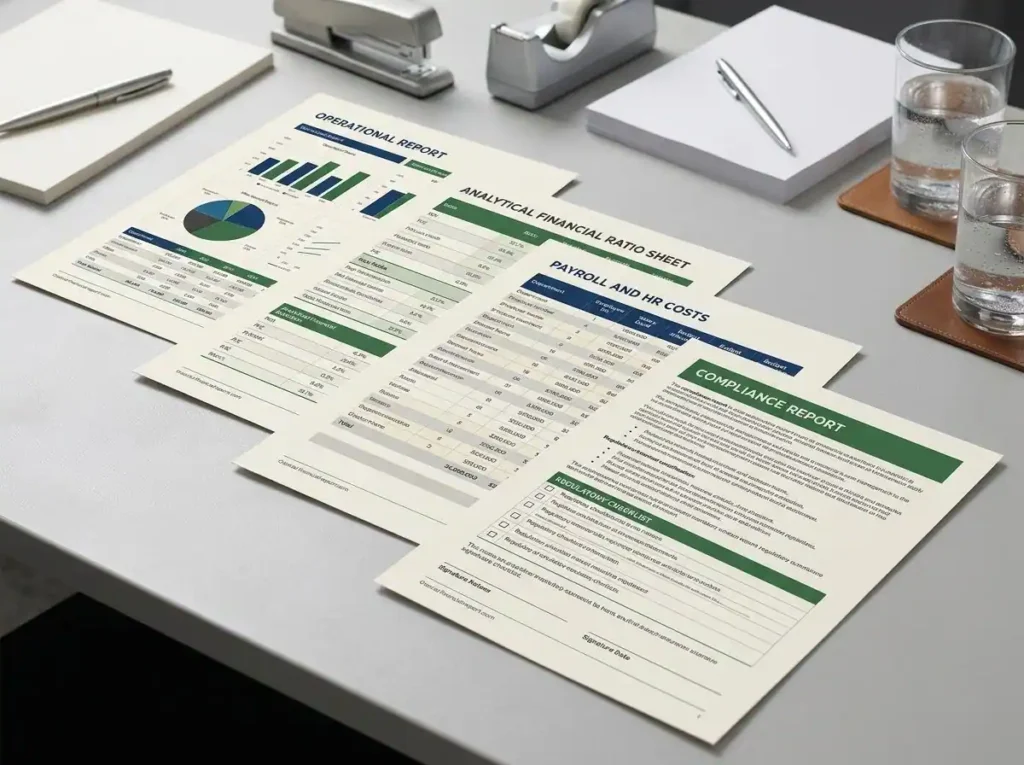
Beyond the standard trio of income statement, balance sheet, and cash flow, there are several specialized types of reports that businesses use each month depending on their industry and size. Understanding these types of reports helps management choose what to track.
- Payroll Summary Report — Breaks down total labor costs including salaries, benefits, and taxes paid during the month.
- Inventory Report — Tracks stock levels, movement, and valuation; essential for product-based businesses.
- Tax Liability Report — Summarizes VAT, withholding taxes, and any other obligations due to the government in the current period.
- Department Cost Report — Allocates expenses by business unit so leadership can see which teams are over or under budget.
- Gross Margin Report — Focuses specifically on the spread between revenue and direct cost of goods or services, useful for pricing analysis.
- Customer Profitability Report — Identifies which clients or contracts are generating real profit versus those that consume resources without adequate return.
- Bank Reconciliation Report — Confirms that the company’s internal records match actual bank statements, a basic but non-negotiable control.
Learn about: characteristics of financial reports
Best Practices for Preparing Monthly Accounting Reports
Getting reports done is not enough — getting them done well is what matters. Here’s what separates mediocre monthly reporting from reporting that actually drives better decisions:
- Close the books on a fixed schedule — Set a hard deadline for data entry cutoff each month. Inconsistent closing dates make comparisons meaningless.
- Reconcile all accounts before generating reports — Never issue a financial report without first confirming that bank accounts, credit cards, and loan balances match their statements.
- Use consistent chart of accounts — Changing how you categorize expenses from month to month destroys the ability to spot trends over time.
- Include a written narrative — Numbers without context are just noise. Add a brief management commentary that explains unusual variances or one-time items.
- Review with department heads — The accounting team should not be the only people looking at these reports. Operations managers, sales leaders, and executives all need to engage with the numbers.
- Automate where possible — Manual data entry is the enemy of accuracy. Use accounting software that pulls transactions directly from bank feeds and integrates with payroll systems.
- Engage a certified accounting office — Complex businesses benefit enormously from having professionals like the team at OMK review reports before distribution, catching errors and providing expert interpretation.
The Importance of Accounting Reports in Managing a Company’s Financial Operations
The role these documents play in day-to-day financial management is impossible to overstate. Here’s why businesses that invest in quality reporting consistently outperform those that don’t:
- They enable informed decision-making — Leadership cannot make smart choices about expansion, hiring, or cost-cutting without accurate, timely financial data.
- They support cash flow planning — By tracking actual cash positions monthly, businesses can anticipate shortfalls weeks before they become crises.
- They build accountability — When departments see their costs reported monthly, spending discipline improves naturally.
- They satisfy lenders and investors — Banks and equity investors expect regular financial reporting as a condition of continued support.
- They simplify tax preparation — Businesses with clean monthly records spend far less time and money when annual tax filings are due.
- They reveal hidden inefficiencies — Regular review of a detailed accounting report often surfaces waste or underperformance that would otherwise go unnoticed for months.
Common Mistakes in Preparing Monthly Accounting Reports
Even experienced finance teams make avoidable errors. Knowing what to watch for is half the battle.
- Skipping reconciliations — Issuing reports before reconciling accounts is the single fastest way to create reports that nobody can trust.
- Mixing personal and business expenses — Especially common in small businesses, this contaminates the data and creates legal exposure.
- Ignoring accruals — Recording expenses only when cash is paid, rather than when they are incurred, distorts the true picture of monthly performance.
- Inconsistent categorization — Booking the same type of expense under different accounts from month to month makes trend analysis impossible.
- Delayed closing — Waiting too long after month-end to finalize reports reduces their usefulness; decisions get made with stale data.
- No review process — A single person preparing and approving their own reports without any second check is an internal control failure waiting to cause a problem.
- Overlooking non-cash items — Depreciation, amortization, and stock-based compensation affect real financial health but are easy to forget in monthly cycles.
The discipline of producing accurate, timely monthly accounting reports is one of the clearest separators between businesses that grow with intention and those that react to crises. These reports are not a luxury — they are the minimum standard for sound financial management. Whether you’re running a startup or an established company, committing to consistent, professional monthly reporting will change how you see your business and how confidently you can lead it. If you’re ready to bring that level of clarity to your finances, reach out to OMK — a certified accounting office built to help businesses like yours get the numbers right, every single month.
Frequently Asked Questions
What should a monthly accounting report include?
At minimum, monthly accounting reports should include an income statement, a balance sheet, and a cash flow statement. Beyond that core set, most businesses benefit from adding accounts receivable aging, accounts payable summaries, and a budget-versus-actual comparison. The right mix depends on the size and complexity of the business, but the principle is consistent: every report package should give management a complete picture of financial performance and position for the period, not just fragments of the story.
How often should a business review its monthly accounting reports?
The short answer is: at least once per month, within the first two weeks after the period closes. What’s interesting here is that many businesses produce the reports but then fail to schedule a formal review meeting — meaning the data sits in an inbox rather than driving decisions. A certified accounting office like OMK recommends a structured monthly financial review meeting that brings together ownership, finance, and key operational leaders to walk through the numbers together and agree on action items.
Can a small business benefit from monthly accounting reports?
Absolutely — in fact, smaller businesses often have more to gain from disciplined monthly reporting than large corporations do, because they have less margin for error. A single bad month of unchecked spending can threaten a small operation in ways that a Fortune 500 company would barely notice. Regular financial reports give small business owners the visibility they need to catch problems early, manage cash carefully, and make the kind of confident decisions that support growth. OMK’s certified accounting office works with businesses at every stage, including startups and SMEs that are building their financial infrastructure from the ground up.