
Understanding the VAT accounting entry is one of those fundamentals that separates businesses that run clean books from businesses that dread every tax audit. Every time a sale or purchase happens, a specific set of debits and credits needs to be recorded — and getting that wrong compounds into real problems fast.
Most business owners assume VAT is just a line on an invoice. Here’s the thing — it’s actually a liability or an asset sitting on your balance sheet until you settle it with the tax authority. That’s exactly why working with a certified accounting office like OMK makes such a difference. Their team handles the details so nothing slips through.
What Are Tax Accounting Entries?
Tax accounting entries are the formal records that capture how taxes affect a company’s financial position. Every tax obligation — whether it’s income tax, withholding tax, or value-added tax — creates a movement between accounts. The accounting system needs to reflect that movement accurately, which is why journal entries are the backbone of any compliant bookkeeping process.
What’s interesting here is that many people treat tax entries as an afterthought — something to sort out at the end of the quarter. In reality, tax entries should be recorded at the moment of each transaction. Waiting creates reconciliation nightmares. Doing it right in real time keeps your accounts clean, your reports accurate, and your tax filings stress-free.

What Is the VAT Accounting Entry?
The VAT accounting entry is the journal entry used to record value-added tax on both sales and purchases. On the sales side, VAT collected from customers creates a liability — you owe that amount to the government. On the purchases side, VAT paid to suppliers creates an asset — it’s money you can potentially reclaim.
These two amounts — output VAT from sales and input VAT from purchases — sit in separate ledger accounts until the end of the tax period. At settlement time, they’re netted against each other. If output VAT exceeds input VAT, you pay the difference. If input VAT is higher, you may carry a credit forward. The VAT accounting entry is the mechanism that tracks this entire cycle, transaction by transaction. A professional certified accounting office structures these accounts from the beginning so the netting process is smooth and accurate.
Learn about: How to Open a Tax Account for Individuals
The Importance of Recording Tax Entries
- Regulatory compliance — Tax authorities require accurate records of every VAT transaction. Missing or incorrect entries can trigger penalties, back-payments, and formal investigations that cost far more than any accounting fee.
- Accurate financial reporting — Tax liabilities and recoverable VAT directly affect your balance sheet and cash flow statement. Without proper entries, your financial statements don’t tell the truth — and decisions made on bad data lead to bad outcomes.
- Smoother VAT filing — When every transaction is entered correctly as it happens, filing becomes a matter of running a report rather than reconstructing months of activity from memory and receipts.
- Audit readiness — Tax audits happen. Businesses with clean, well-documented entries move through them quickly. Businesses without proper records spend weeks scrambling.
- Cash flow planning — Knowing your VAT position at any given moment lets you plan for the VAT payment that’s coming. There are no surprises at the end of the period.
- Investor and lender confidence — Creditors and investors look at your books. Clean tax entries signal a well-managed business, which opens doors that messy accounting closes.
Tax Entries on Company Income
- Debit — Income Tax Expense: This records the cost of income tax in the profit and loss account for the period in which it was earned, following the accruals principle.
- Credit — Income Tax Payable: This creates a liability on the balance sheet representing the amount owed to the tax authority until the cash payment is made.
- Debit — Income Tax Payable (at payment): When the payment is actually made, the liability account is cleared by debiting it.
- Credit — Cash or Bank (at payment): The corresponding credit removes the funds from the company’s bank account, completing the entry cycle.
- Deferred tax entries may also arise when accounting income and taxable income differ — these require additional debit or credit entries to a deferred tax asset or liability account depending on the timing difference.
Tax Entries on Sales Due
- Debit — Accounts Receivable or Cash: When a sale is made, the full amount including VAT is debited to reflect what the customer owes or what was collected.
- Credit — Sales Revenue: Only the net amount before VAT is credited to the revenue account. VAT is never part of your revenue — it belongs to the government.
- Credit — Output VAT Payable: The VAT portion of the sale is credited to a separate liability account. This is the sales journal entry that most businesses need to get right from day one.
- Periodic netting entry: At the end of each tax period, the output VAT payable account is reconciled against recoverable input VAT. The difference determines what is actually owed or recoverable.
- VAT payment entry: When the net VAT amount is paid to the tax authority, the payable account is debited and the bank account is credited, completing the cycle.
VAT Journal Entries
- The VAT accounting entry on sales always splits the transaction into two credits: one to revenue and one to the output VAT liability account. Never mix these two — combining them is one of the most common errors OMK’s certified accounting office corrects when onboarding new clients.
- Input VAT paid on eligible purchases is recorded as a debit to a recoverable VAT asset account. This is the purchase journal entry that forms the basis of your VAT refund or offset claim.
- When VAT is both collected and paid within the same period, the two balances are offset against each other in a netting entry before the final VAT payment is made to the authority.
- Exempt supplies and zero-rated supplies require separate treatment. Zero-rated sales still generate a VAT entry — just at 0% — while exempt supplies generate no VAT entry at all. Confusing these two categories creates filing errors.
- Partial exemption situations — where a business makes both taxable and exempt supplies — require an apportionment calculation before recording the recoverable portion of input VAT.
VAT Paid on Purchases Journal Entries in Saudi Arabia
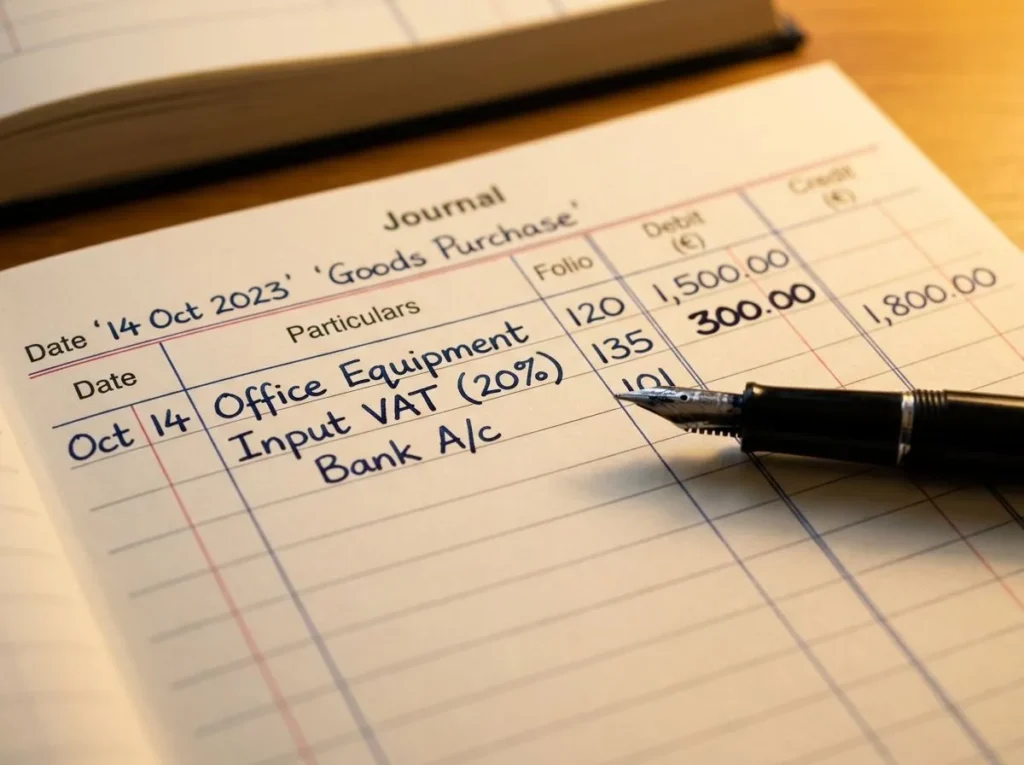
- In Saudi Arabia, the standard VAT rate is 15%. Every purchase journal entry for a VAT-registered supplier must therefore split the invoice into the net cost (debited to the relevant expense or asset account) and the 15% VAT component (debited to the recoverable input VAT account).
- The VAT payment deadline in Saudi Arabia is the last day of the month following the end of the tax period. For monthly filers, that means payment is due by the end of the following month. Missing this deadline triggers automatic penalties.
- Credit purchases follow the same structure: debit the expense or asset account, debit input VAT recoverable, and credit accounts payable for the full invoice amount including VAT.
- Cash purchases hit the bank account directly: debit the expense or asset, debit input VAT recoverable, and credit cash for the gross amount.
- Import VAT — paid at customs on goods brought into Saudi Arabia — is recorded the same way as domestic purchase VAT, with careful attention to the customs documentation as the source record for the entry.
- OMK’s certified accounting office ensures that every purchase entry in Saudi Arabia is mapped to the correct ZATCA-compliant account structure, so your VAT returns reconcile cleanly with your general ledger every single time.
Learn about: What Is a Tax Identification Number?
Frequently Asked Questions
What is the difference between input VAT and output VAT in journal entries?
Output VAT is the tax you collect from your customers when you make a taxable sale — it’s recorded as a credit to a liability account because you owe it to the tax authority. Input VAT is the tax you pay to your suppliers on eligible purchases — it’s recorded as a debit to an asset account because it’s recoverable. At the end of each tax period, you offset these two amounts. The net position determines whether you make a VAT payment or carry a credit forward.
What is the VAT payment deadline in Saudi Arabia?
The VAT payment deadline in Saudi Arabia depends on your filing frequency. Monthly filers must submit their return and pay any VAT due by the last day of the month following the tax period. Quarterly filers follow the same rule but on a three-month cycle. Missing the deadline results in financial penalties, so many businesses choose to work with a certified accounting office like OMK to ensure filings are prepared and submitted on time without last-minute pressure.
Can a small business handle VAT accounting entries without an accountant?
Technically, yes — but practically, it’s risky. The VAT accounting entry rules involve nuances like partial exemption, zero-rating versus exemption, import VAT treatment, and the correct separation of revenue from tax. Errors in any of these areas lead to misstated financial reports and incorrect VAT returns. OMK’s certified accounting office works with small and medium businesses specifically to set up the right account structure from the start, making daily bookkeeping straightforward even for non-accountants.
Getting the VAT accounting entry right isn’t just a technical requirement — it’s a foundation for accurate reporting, smooth tax filings, and real financial clarity. From the purchase journal entry that captures input VAT to the sales journal entry that separates revenue from output VAT, every transaction tells a story that your ledger needs to record faithfully. Whether you’re navigating the VAT payment deadline in Saudi Arabia or setting up your chart of accounts for the first time, the details matter. Reach out to OMK’s certified accounting office for expert guidance tailored to your business — they’ll make sure your VAT accounting is done right, every time.